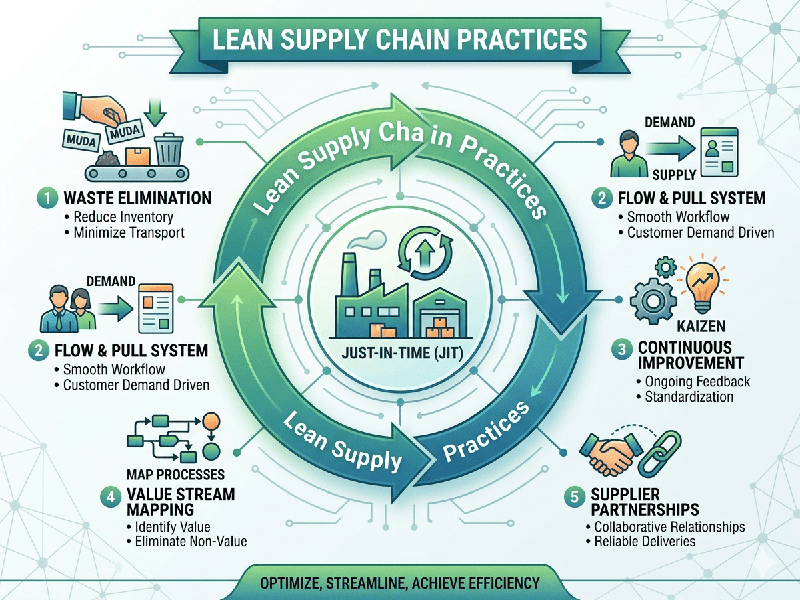
Lean Supply Chain Practices
Lean
Supply Chain
practices have moved beyond simple waste reduction to focus on dynamic flow
and resilient agility. The goal is to maximize customer value while
minimizing non-value-added activities (waste) throughout the entire journey
from raw material to the end user.
The 8
Wastes in a Modern Supply Chain (DOWNTIME)
To implement
Lean, you must first identify the "hidden" wastes within the network:
- Defects: Returns, damaged goods, or
incorrect data entries.
- Overproduction: Manufacturing more than the
current demand dictates.
- Waiting: Goods stuck in customs, idle
trucks, or delayed approvals.
- Non-Utilized Talent: Failing to leverage the
insights of frontline warehouse workers.
- Transportation: Unnecessary movement of goods
between warehouses.
- Inventory: Excess stock sitting in
storage, tying up capital.
- Motion: Inefficient physical movement
within a fulfillment center.
- Extra-Processing: Redundant inspections or
over-packaging.
Core Lean
Practices for 2026
1.
Demand-Driven Pull Systems (Kanban)
Instead of
"Pushing" inventory based on long-term (and often inaccurate)
forecasts, a "Pull" system triggers production only when a customer
consumes an item.
- 2026 Evolution: e-Kanban systems now use
real-time IoT sensors to automatically signal upstream suppliers the
moment a pallet leaves the shelf.
2.
Just-In-Time (JIT) vs. Just-In-Case (JIC)
While JIT
was the gold standard for decades, modern Lean practices emphasize "Smart
JIT." This involves using AI to predict local disruptions, allowing
for a strategic "buffer" of critical components while keeping
non-essential parts on a strict JIT schedule.
3. Kaizen
(Continuous Improvement)
Lean is a
culture, not a project.
- Gemba Walks: Managers physically visit the
"actual place" (the warehouse floor or the shipping dock) to see
processes firsthand and identify bottlenecks.
- Standardized Work: Documenting the "best
known way" to perform a task to reduce variability and errors.
4. Value
Stream Mapping (VSM)
VSM is a
visual tool used to map the flow of materials and information. It helps
identify exactly where a product is "sitting" versus
"moving."
- Focus: In 2026, VSMs specifically
target "Information Lead Time"—the time it takes for a
sales order to actually become a production instruction.