Kubernetes Security Posture
Maintaining a strong Kubernetes Security Posture
in 2026 requires a "Defense in Depth" strategy, applying security
controls across the entire lifecycle—from the build phase to runtime.
1. The Foundation: Kubernetes Security Posture
Management (KSPM)
KSPM is the framework for ensuring your clusters
remain secure as they scale. It involves:
- Continuous Configuration
Scanning: Using
tools (like kube-bench or Kubescape) to automatically detect
misconfigurations against industry standards (e.g., CIS Benchmarks).
- Policy-as-Code: Enforcing consistent rules
using engines like OPA Gatekeeper or Kyverno to prevent
insecure deployments (e.g., containers running as root).
- Centralized Visibility: A single dashboard to monitor
compliance, identify "toxic combinations" (e.g., an exposed
workload with overly permissive RBAC), and track configuration drift.
2. The Lifecycle Approach
- Build Phase: Scan container images for
vulnerabilities in your CI/CD pipeline and block the deployment of images
with critical vulnerabilities. Use trusted, minimal base images.
- Runtime Phase: Monitor for anomalous behavior
(e.g., unexpected shell execution or network calls) using eBPF-based tools
like Falco.
- Infrastructure: Secure the nodes themselves by
using minimal OS distributions, patching regularly, and isolating the etcd
database.
3. Strategic Implementation Roadmap
1.
Observe First:
Roll out controls (like NetworkPolicies or Pod Security) in audit or warn mode
to identify what breaks before enforcing them.
2.
Automate Remediation: Where possible, use KSPM tools to automatically flag or remediate common
misconfigurations, such as inactive service accounts.
3.
Shift Left:
Integrate security checks directly into the developer workflow so that
infrastructure-as-code (IaC) templates are scanned before they are ever applied
to a cluster.
Q-9 Demand-Driven
SCM
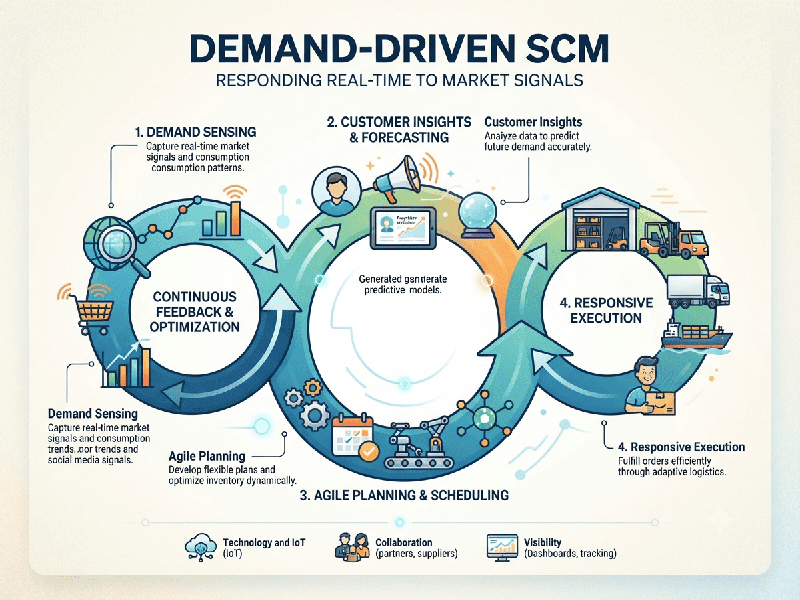
Demand-Driven Supply Chain Management (DDSCM) is a
strategic approach that prioritizes actual customer demand signals over
traditional forecasting to drive decision-making across the supply chain.
Instead of producing and stocking goods based on
estimates—which often leads to the "bullwhip effect" (where small
changes in demand cause massive, inefficient swings in production)—a
demand-driven model uses real-time data to "pull" products through
the supply chain only when needed.
Core Components
To move from a traditional model to a demand-driven
one, organizations generally focus on these four pillars:
- Real-Time Visibility &
Collaboration:
Integrating data flows from the "shop floor to the top floor."
By sharing information openly with suppliers and partners, companies can
gain visibility into inventory levels, market trends, and supplier
performance.
- Dynamic Inventory Management: Moving away from static,
fixed-level safety stock. DDSCM uses strategically placed "buffer
inventories" that are automatically replenished based on consumption,
helping to decouple processes and mitigate variability.
- Agile Production Processes: Creating flexible manufacturing
systems that can rapidly adjust to volume changes or product variants.
This often involves "just-in-time" principles and the ability to
scale production based on actual confirmed orders.
- Customer-Centric Strategies: Placing the customer at the
center of the design. This involves using data analytics to anticipate
specific customer needs, ultimately aiming to deliver personalized
experiences and faster service.
Key Benefits
Implementing a demand-driven approach often results in
a leaner, more responsive organization:
- Reduced Costs: Lower inventory carrying costs
and minimized waste from overproduction.
- Increased Agility: The ability to respond faster
to market shifts, reducing the risk of stock-outs or dead stock.
- Higher Profitability: By aligning production exactly
with what the customer wants, businesses can improve margins and reduce
the need for deep discounting or order-expediting expenses.
- Improved Collaboration: Stronger relationships with
partners as the focus shifts from transactional buying to joint
coordination and risk sharing.