Finance APIs for Automation
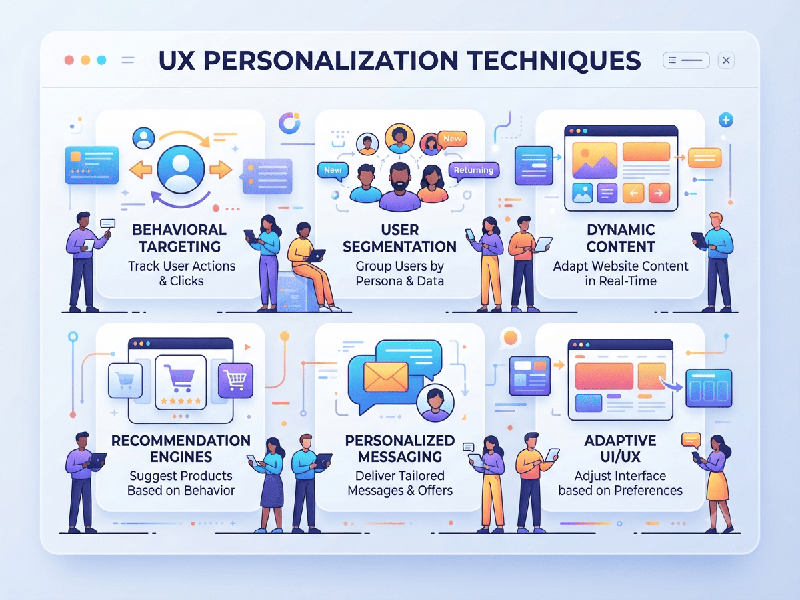
Personalization in 2026 has evolved beyond simple
"welcome back" banners. The focus is now on hyper-personalization
driven by AI, context-aware systems, and multimodal interactions.
To implement effective UX personalization, integrate
these techniques into your design strategy:
1. Data-Driven Foundation
Personalization is only as good as the data powering
it. Use a mix of data types to build a "single customer view":
- Behavioral Data: Use clicks, scroll depth, and
feature usage to map how users actually interact with your product.
- Contextual Data: Tailor the experience based on
the "moment," such as device type, location, time of day, or
current environment.
- Explicit Preferences: Capture goals, industry, or
role during onboarding via quick, low-friction quizzes.
2. Adaptive & Intelligent Interfaces
Move away from static, "one-size-fits-all"
layouts toward systems that evolve with the user.
- Modular Layouts: Build interfaces as sets of
interchangeable components. Use conditional logic to rearrange, hide, or
emphasize specific modules based on user segments (e.g., administrator vs.
operator views).
- Predictive Suggestions: Surface content or actions before
the user explicitly asks for them, similar to how navigation apps predict
destinations based on time and history.
- Designing for Intent: Instead of mapping fixed
actions, map user intent. If the system understands a user's goal,
it can adjust the navigation path or information density to help them
reach it faster.
3. Multimodal & Context-Aware Personalization
In 2026, personalization spans beyond screens to
include voice, haptics, and gaze.
- Seamless Switching: Ensure the experience is
consistent as users switch between modes (e.g., shifting from visual
planning on a screen to voice guidance while on the move).
- Environmental Awareness: Adjust interfaces based on the
user's situation. For example, simplify UI elements or increase contrast
when the system detects high-distraction or low-light environments.
4. Implementation Best Practices
- Prioritize Transparency &
Control: Users
value privacy. Be clear about what data is collected and why. Always
provide a simple, accessible way for users to opt out or modify their
personalization settings.
- The "Natural" Feel: Personalization should feel
like the system "just knows" you, not like it is manipulating
you. Avoid intrusive "flashy" banners; instead, use subtle cues
like reordering lists or providing relevant shortcuts.
- Start with High-Impact Areas: Don't try to personalize
everything at once. Begin with critical flows like onboarding, dashboard
views, or search results where the benefit to the user is immediately
obvious.
- Continuous Feedback Loops: Treat every personalized
feature as a hypothesis. Use A/B testing and session analytics to measure
if your changes actually reduce task time or increase retention.
5. Ethical Design
- Avoid "Bubbles": If you only show users content
similar to what they’ve already liked, you risk stagnation. Always reserve
a portion of the interface for new, popular, or diverse content to
encourage discovery.
- Human Fallback: When using AI-driven
personalization (like chatbots or automated recommendations), always
provide a way to reach a human or override the system if the AI gets it
wrong.