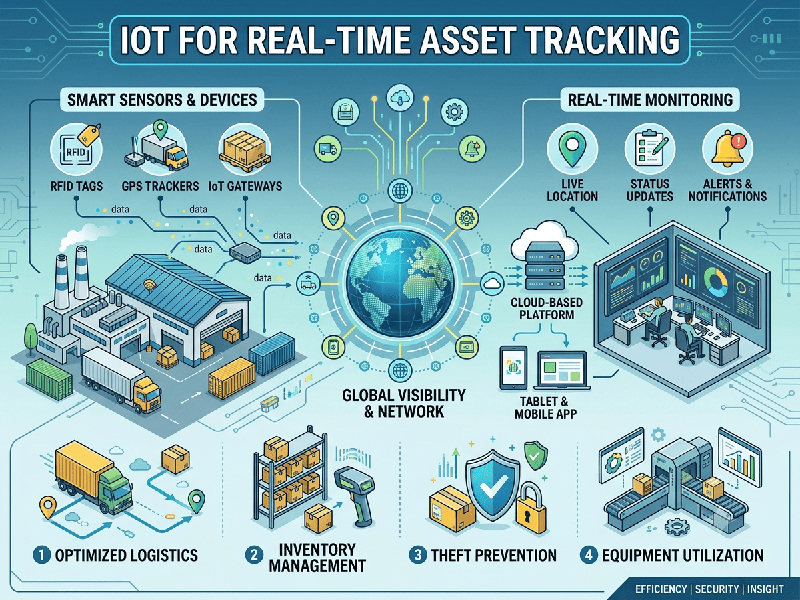
IoT for Real-Time Asset Tracking
IoT-based real-time asset tracking is a system that
uses interconnected sensors, connectivity protocols, and cloud platforms to
monitor the location, status, and health of physical assets—such as vehicles,
equipment, inventory, or machinery—in real time.
By moving from manual, periodic checks to continuous
automated monitoring, organizations gain visibility into their supply chain,
reduce loss, and optimize operational efficiency.
How the System Works
The process follows a logical flow from the physical
asset to the end-user dashboard:
1.
Data Collection (Sensors & Tags): Physical assets are equipped with sensors or tags.
These devices capture data such as GPS coordinates, temperature, vibration (for
maintenance), humidity, or motion.
2.
Connectivity (Transmission): The collected data is sent to a central system. The choice
of technology depends on the environment:
o GPS/GNSS: Used for outdoor, global tracking of
vehicles or shipping containers.
o RFID (Radio-Frequency
Identification):
Ideal for short-range, rapid scanning of inventory within warehouses.
o BLE (Bluetooth Low Energy): Excellent for power-efficient indoor
tracking and proximity-based positioning.
o LPWAN (e.g., LoRaWAN, NB-IoT): Designed for low-power, long-range
communication over wide areas.
o Cellular (4G/5G/LTE): Used for reliable, high-bandwidth
tracking of assets across large geographical areas.
3.
Processing & Analytics: Data is sent to the cloud or an edge gateway. Here, it is
filtered, stored, and analyzed—often using machine learning to detect patterns
or predict maintenance needs.
4.
User Interface (Visualization): The final insights are presented to stakeholders via a
dashboard or application, showing live locations, alerts for geofence breaches,
or equipment performance metrics.
Key Benefits
- Real-Time Visibility: Constant, up-to-the-minute
awareness of where assets are located anywhere in the world.
- Predictive Maintenance: Sensors monitor performance
metrics (like vibration or temperature). By identifying anomalies early,
you can repair equipment before it breaks, reducing costly downtime.
- Improved Security & Loss
Prevention:
Through "Geofencing"—a virtual boundary—the system can send
instant alerts if an asset leaves a predefined area, acting as a major
deterrent against theft.
- Operational Optimization: Analytics reveal how assets are
being used, allowing managers to identify underutilized equipment or
inefficiencies in workflows.
- Increased Accuracy: Automated data collection
eliminates the human error inherent in manual inventory tracking or
logging.