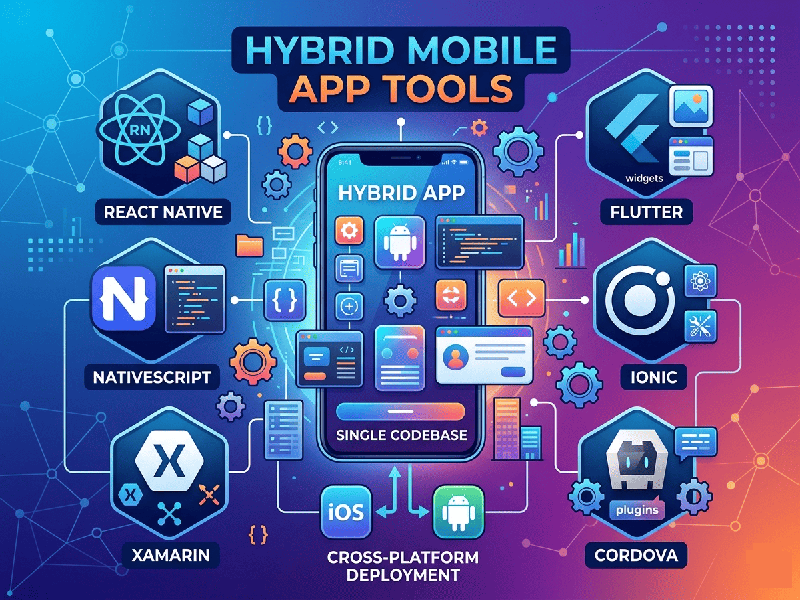
Hybrid Mobile App Tools
Hybrid mobile app development has evolved significantly,
moving away from simple "web-wrappers" toward sophisticated
frameworks that offer near-native performance. In 2026, the choice of tool
depends largely on your team's existing skill set and the complexity of the
user interface you aim to build.
1. Top Tier: Performance & High Fidelity
These frameworks are the industry standard for
high-performance apps that feel genuinely native.
Flutter (by Google)
Flutter remains a leader due to its Impeller rendering
engine, which ensures smooth animations (up to 120 FPS) by drawing every
pixel directly on a canvas rather than using native OS components.
- Language: Dart.
- Best For: Design-heavy apps, custom
branded UIs, and complex animations.
- Key Feature: "Hot Reload" allows
developers to see code changes in sub-seconds without losing the app
state.
React Native (by Meta)
React Native is the go-to for teams already proficient in
JavaScript or React. Its "New Architecture" (Fabric and TurboModules)
has eliminated many of the historical performance "bridge"
bottlenecks.
- Language: JavaScript / TypeScript.
- Best For: Content-driven apps (like
social media or e-commerce) where a native look-and-feel is preferred.
- Key Feature: Massive ecosystem of libraries
and a large talent pool, making hiring easier.
2. The Logic-Sharing Specialists
These tools prioritize "native-first" UIs while
sharing the "brain" (business logic) of the app across platforms.
Kotlin Multiplatform (KMP)
KMP has become a "rising star" in 2026. Unlike
Flutter, it doesn't try to draw the UI. Instead, you write your networking and
data logic once in Kotlin and then build 100% native UIs using SwiftUI (iOS)
and Jetpack Compose (Android).
- Best For: Scale-ups migrating from native
apps or teams that refuse to compromise on native UI performance.
3. Web-to-Mobile Ecosystems
Ideal for web developers who want to ship to the App Store
using the languages they already know.
Ionic & Capacitor
Ionic uses Capacitor as a modern "bridge" to
access native device features (camera, GPS, etc.). It essentially runs your web
app inside a native container.
- Tech Stack: HTML, CSS, JavaScript (works
with Angular, React, or Vue).
- Best For: Rapid prototyping, MVPs, and
internal corporate tools where ultra-high performance isn't the primary
concern.