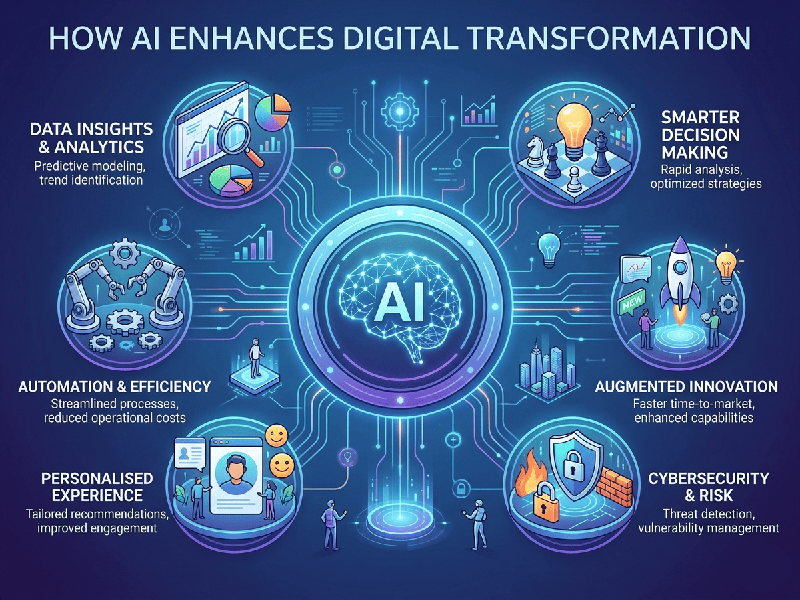
How AI Enhances Digital Transformation
Digital transformation once focused on simply moving from paper to software. In 2026, it has evolved into AI-driven transformation, where the goal is no longer just "going digital" but becoming intelligent, predictive, and adaptive.
1. From Simple Automation to "Agentic AI"
Traditional digital tools automated repetitive tasks based on
"if-then" logic. Modern transformation uses Agentic AI—autonomous
systems capable of planning, acting, and learning to achieve complex goals.
- The Shift: Instead of a software tool just
recording an invoice, an AI agent can now negotiate with a supplier,
verify delivery, and trigger payments independently.
- Impact: This reduces manual review time
by up to 85% in sectors like legal and finance.
2. Predictive Insights vs. Rearview Analytics
Digital transformation previously provided "descriptive
analytics" (telling you what happened yesterday). AI provides a forward-looking
dashboard.
- Hyper-Personalization: AI analyzes real-time behavior
to deliver "segment of one" experiences, predicting what a
customer wants before they search for it.
- Demand Sensing: In manufacturing and
export-import, AI identifies potential supply chain disruptions weeks in
advance by analyzing global signals, allowing companies to pivot
proactively.
3. Hyperautomation of Core Workflows
AI integrates with Robotic Process Automation (RPA) and cloud architecture to create "closed-loop" systems.
- Financial Impact: Companies leveraging AI-driven
procurement and supply chain agents (like Unilever) have reported annual
savings in the range of $250 million.
4. Zero-Trust and AI-Powered Security
As businesses move entirely to the cloud, the
"perimeter" disappears. AI enhances digital security by:
- Anomaly Detection: Identifying "impossible
travel" or unusual data access patterns in milliseconds.
- Proactive Defense: Moving beyond reactive patches
to predictive threat modeling, where AI simulates potential attacks to
find vulnerabilities first.
5. Enabling the "Cloud-Native" Enterprise
AI optimizes the very infrastructure it runs on.
- Cost Optimization: AI-driven tools now manage
multi-cloud environments (GCP, Azure, AWS) to dynamically shift workloads
to the most cost-effective or energy-efficient servers in real-time.
- Sustainable Scaling: 2026 trends show AI being used
to manage data center cooling and energy loads, aligning digital growth
with corporate climate goals.