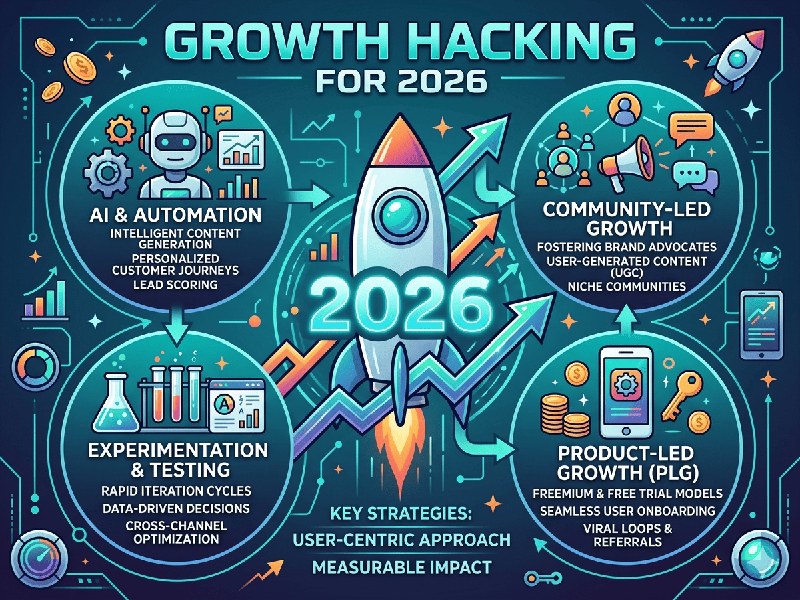
Growth Hacking for 2026
In 2026, growth hacking has transitioned from "scrappy tactical tricks" to AI-agentic systems and community-led ecosystems. The focus has shifted from merely driving clicks to securing visibility in "Answer Engines" (like SearchGPT and Perplexity) and building deep user retention.
1. From SEO to GEO (Generative Engine Optimization)
Traditional SEO (ranking blue links) is no longer enough.
Growth hackers now focus on GEO to ensure their brand is cited in
AI-generated summaries.
- LLM Optimization: Use structured data and
"Relevance Engineering" to help AI models understand your
business as a trusted entity.
- Zero-Click Visibility: Optimize for the "Answer
Box." Success is measured by being the primary source cited by an AI
assistant during a user's research phase.
- Agentic SEO: Deploying autonomous AI agents
that analyze search intent and update site metadata in real-time to match
shifting semantic trends.
2. Community-Led Growth (CLG)
With AI content flooding the web, human trust has become the
rarest commodity. Growth is now driven by communities, not just funnels.
- Collaborators, Not Consumers: Successful brands treat users
as co-creators. This includes using "Customer Advisory Boards"
to shape product roadmaps.
- Ritualized Engagement: Instead of one-off ads, growth
hackers build "engagement rituals" (e.g., weekly private
workshops, exclusive Discord forums) that turn users into advocates.
- Trust Scaling: A thriving community acts as a
self-sustaining referral engine, which is far more cost-effective than
rising CAC (Customer Acquisition Cost) on traditional social platforms.
3. The "Prototype Economy" & AI Personalization
The speed from idea to execution has collapsed. Growth
hackers now use AI to run hundreds of micro-experiments simultaneously.
- Hyper-Personalized Journeys: AI engines now predict the next
best action for a user in real-time, tailoring the entire UI/UX to their
specific profile and behavior.
- Programmatic Content Scaling: Using AI to generate thousands
of high-quality, niche-specific landing pages or educational guides (e.g.,
"Export Documentation for SME Ceramics in Gujarat") that target
long-tail, high-intent queries.
- Predictive Churn Prevention: Machine learning models
identify "at-risk" users before they leave, triggering
automated, personalized re-engagement offers.
4. B2B & International Trade Growth (India Focus)
For those focusing on the Indian market and global trade, the
growth stack has become highly specialized:
- Marketplace Dominance: Leveraging verified B2B
platforms (like IndiaMART, TradeIndia, or Pepagora) as the primary lead
generation engine.
- Transparency as a Growth Lever: Providing clear Incoterms (FOB,
CIF), real-time logistics tracking, and verified certifications directly
on product listings to reduce "Buyer Hesitation."
- Regional Localization: Growth hacking in India now
requires "hyper-local" content—optimizing listings and ads in
regional languages to capture demand in Tier 2 and Tier 3 cities.