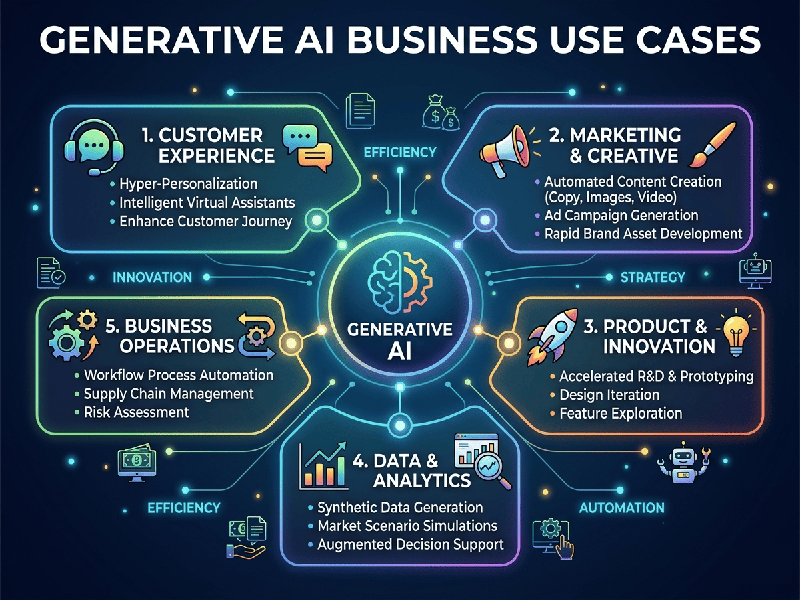
Generative AI Business Use Cases
As we move into 2026, Generative AI has transitioned from
simple "chatbots" to Agentic Workflows—systems that don't just
talk, but actually perform multi-step business processes.
Below are two distinct ways to categorize these use cases:
one by Internal Operational Efficiency and the other by Strategic
Growth & Market Intelligence.
Operational Efficiency & Process Automation
This perspective focuses on "doing more with less"
by automating the heavy lifting within your current business structure.
1. Supply Chain & Logistics Intelligence
- Customs Compliance Automation: GenAI now automates the
generation of Customs Declarations, HS/HTS code classification, and
creates "Draft Packing Lists" by reading technical
specifications.
- Intelligent Exception
Management: If
a shipment is delayed at a port, AI agents can automatically draft
alternative routing scenarios and communicate the impact to all
stakeholders in real-time.
- Post-Mortem Reporting: Automatically generating
detailed incident reports after a logistical disruption to identify root
causes and suggest preventive measures.
2. Financial & Legal Operations
- Automated Regulatory Filings: AI drafts earnings summaries
and compliance reports directly from raw ERP data.
- Contract Intelligence: LLMs can scan thousands of
supplier contracts to identify unapplied volume discounts or risky penalty
clauses that humans might miss.
- Scenario-Based Budgeting: Instead of a single point
forecast, AI generates range scenarios (e.g., "What if the RBI repo
rate changes by 0.25%?") and drafts the corresponding budget
adjustments.
3. Technical Debt & IT Management
- Code Modernization: Converting legacy systems (like
old COBOL or manual Excel-based tracking) into modern microservices or
cloud-native architectures.
- Low-Code Business Tools: Enabling non-technical staff to
build internal apps (like a custom inventory tracker) using natural
language prompts.