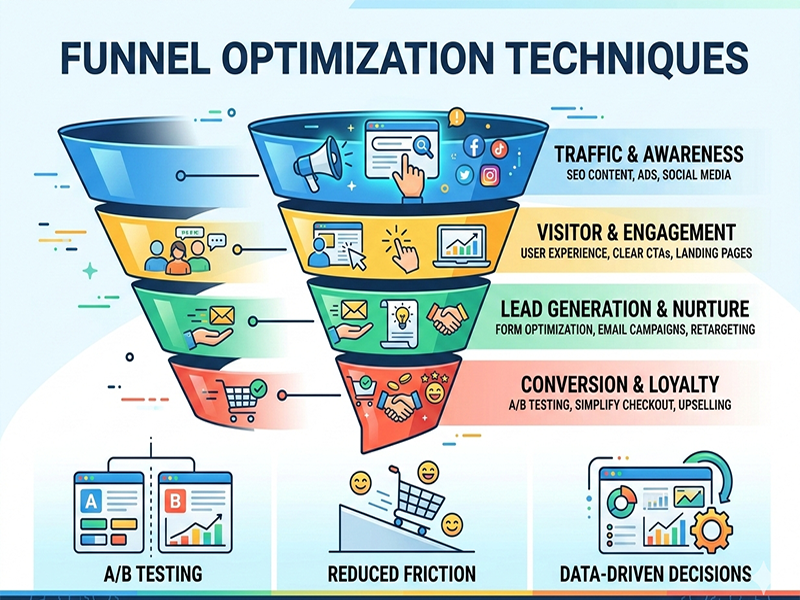
Funnel Optimization Techniques
Funnel
optimization is the process of streamlining the "path to purchase" by
identifying where users drop off and fixing those leaks. In 2026, the focus has
shifted from linear funnels to Flywheels, where the goal is not just a
one-time sale but creating a loop of continuous engagement.
1. Top of
Funnel (TOFU): Awareness & Interest
At this
stage, the goal is to capture attention without being intrusive.
- The "Rule of One": Each landing page should have one
clear value proposition and one primary action.
- Information Symmetry: Ensure the "scent" of
your ad matches the landing page. If an ad promises "50% off
sneakers," the landing page must immediately show sneakers at that
discount, not a generic homepage.
- Progressive Profiling: Don't ask for 10 pieces of
information at once. Ask for an email first, then collect more data as the
relationship grows.
2. Middle
of Funnel (MOFU): Consideration & Evaluation
Users are
now comparing you to competitors. You need to build "Micro-Moments"
of trust.
- The Contrast Principle
(Anchoring):
Present your "Pro" plan next to a "Basic" and
"Enterprise" plan. By highlighting the middle option as
"Most Popular," you provide a psychological anchor that makes
the price seem more reasonable.
- Risk Reversal: Use explicit guarantees like
"No credit card required," "Money-back guarantee," or
"Cancel anytime." This removes the "fear of regret."
- Interactive Content: Quizzes, calculators, and
product finders engage the user's brain more effectively than static text,
leading to higher "intent" scores.
3. Bottom
of Funnel (BOFU): Conversion & Action
This is the
most fragile stage. Any friction here will result in abandoned carts.
- Enclaved Checkout: Remove the main navigation menu
during checkout. This prevents users from wandering away from the payment
screen.
- Visual Salience (The Von
Restorff Effect): Your "Buy Now" button should be the most visually
distinct element on the page (using high-contrast colors).
- The "Zeigarnik
Effect":
Use a progress bar (e.g., Step 2 of 3). Humans have a natural
psychological drive to complete a task once it has been started.
4.
Post-Purchase: Retention & Referral
The funnel
doesn't end at the "Thank You" page.
- The "Aha!" Moment: Guide the user to find the core
value of your product as quickly as possible (e.g., getting a user to
follow 5 friends on a social app).
- Reciprocity Loops: Offer a discount on their next
purchase immediately after they buy.
- Social Amplification: Ask for a referral or review
only after the user has achieved a "win" within your
product.