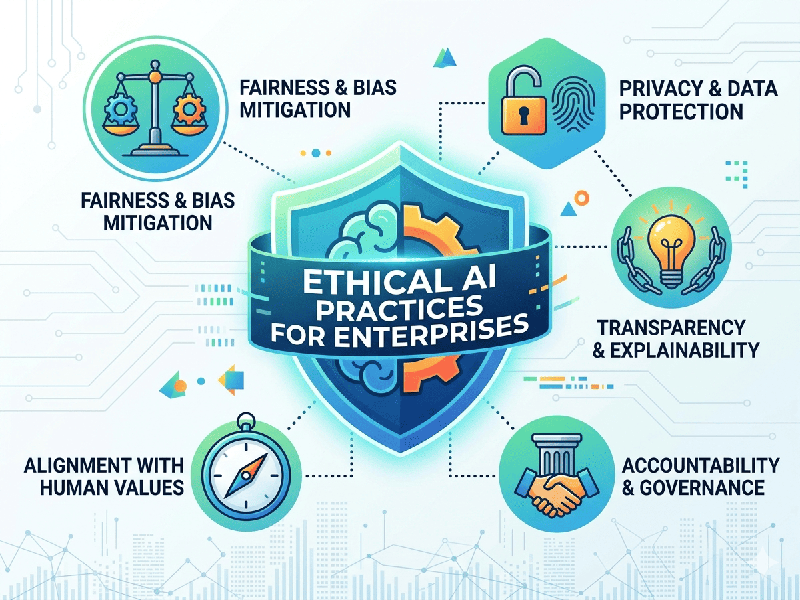
Ethical AI Practices for Enterprises
For enterprises, the shift from "AI
experimentation" to "AI production" requires a robust ethical
framework. It’s no longer just about whether the model can do something,
but whether it should.
1. Governance and Accountability
Enterprises must establish clear lines of responsibility for
AI outcomes.
- AI Ethics Board: Create a cross-functional
committee (legal, tech, HR, and diversity officers) to review high-stakes
deployments.
- Human-in-the-Loop (HITL): Ensure critical
decisions—especially those affecting livelihoods, credit, or safety—have a
human reviewer to override automated errors.
- Audit Trails: Maintain detailed logs of data
sources, model versions, and decision logic to ensure traceability during
regulatory inquiries.
2. Bias Mitigation and Fairness
AI models often mirror the biases present in their training
data.
- Diverse Datasets: Actively seek out data that
represents all demographics to prevent skewed results.
- Pre-computation Testing: Use fairness metrics to test
for "disparate impact" before a model goes live.
- Regular Bias Audits: Since data drifts over time,
schedule recurring checks to ensure the model hasn't developed new biases
against specific protected groups.
3. Transparency and "Explainability" (XAI)
The "black box" nature of AI is a major ethical
hurdle. Stakeholders must understand why an AI reached a specific conclusion.
- Explainable AI (XAI) Tools: Implement techniques like SHAP
or LIME to visualize which features (e.g., income, location, age) most
influenced an AI's decision.
- Clear Disclosures: Always inform users when they
are interacting with an AI or when an AI has influenced a decision
regarding them.
4. Privacy and Data Stewardship
Ethical AI respects the sanctity of user data.
- Data Minimization: Only collect the data strictly
necessary for the model’s function.
- Anonymization: Use differential privacy or
synthetic data to train models without exposing Personally Identifiable
Information (PII).
- Consent Management: Ensure users have a clear way
to opt-in or opt-out of their data being used for model training.
5. Security and Robustness
An ethical model must be safe from manipulation and resilient
to failure.
- Adversarial Testing: Stress-test models against
"prompt injections" or "data poisoning" where
malicious actors try to force the AI into unethical behavior.
- Reliability Limits: Clearly define the
"operational domain" of the AI. If a model is designed for
financial forecasting, it should have guardrails to prevent it from giving
medical advice.