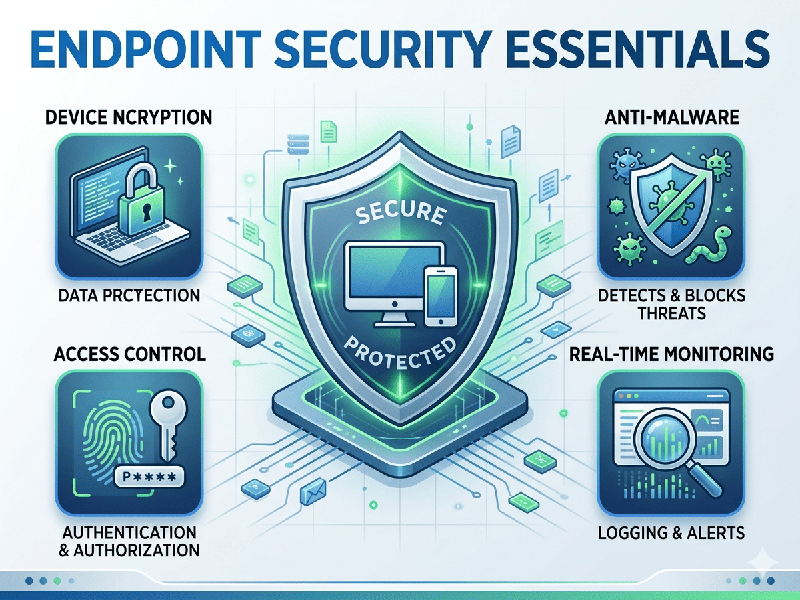
Endpoint Security Essentials
Endpoint
security is the practice of protecting the entry points of end-user
devices—such as desktops, laptops, and mobile devices—from being exploited by
malicious actors. As remote work and cloud integration become the standard, the
endpoint is often the primary frontline of defense.
1. Core
Technological Components
Modern
endpoint protection goes beyond traditional antivirus by using a layered
approach:
- Next-Generation Antivirus
(NGAV): Unlike
legacy systems that rely on signatures of known viruses, NGAV uses AI and
machine learning to identify suspicious patterns and "fileless"
malware.
- Endpoint Detection and Response
(EDR): This
provides continuous monitoring and data collection. If a breach occurs,
EDR allows security teams to "trace back" the attack to see how
it entered and what it touched.
- Managed Detection and Response
(MDR): This is
EDR delivered as a service, where third-party experts monitor your
endpoints 24/7.
- Data Loss Prevention (DLP): These tools prevent sensitive
data (like financial records or customer PII) from leaving the device via
unauthorized channels like USB drives or personal email.
2.
Essential Security Practices
Technology
is only effective when paired with strict operational protocols:
- Patch Management: Regularly updating operating
systems and applications is critical. Most "zero-day" exploits
target known vulnerabilities that simply haven't been patched on the
user's device.
- Principle of Least Privilege
(PoLP): Users
should only have the minimum level of access required to do their jobs.
This prevents a compromised endpoint from granting an attacker
administrative rights to the whole network.
- Device Encryption: Full-disk encryption ensures
that if a laptop is physically stolen, the data remains inaccessible
without the recovery key.
3. The
Human Element
End-user
behavior is often the weakest link in the security chain:
- Multi-Factor Authentication
(MFA):
Requiring a second form of verification (like a mobile app code or a
hardware key) is the most effective way to prevent unauthorized access
from stolen credentials.
- Security Awareness Training: Employees must be trained to
recognize phishing attempts, social engineering, and the risks of using
unsecured public Wi-Fi.
- Email Security: Since many endpoint attacks
begin with a malicious link or attachment, robust email filtering is a
prerequisite for endpoint safety.