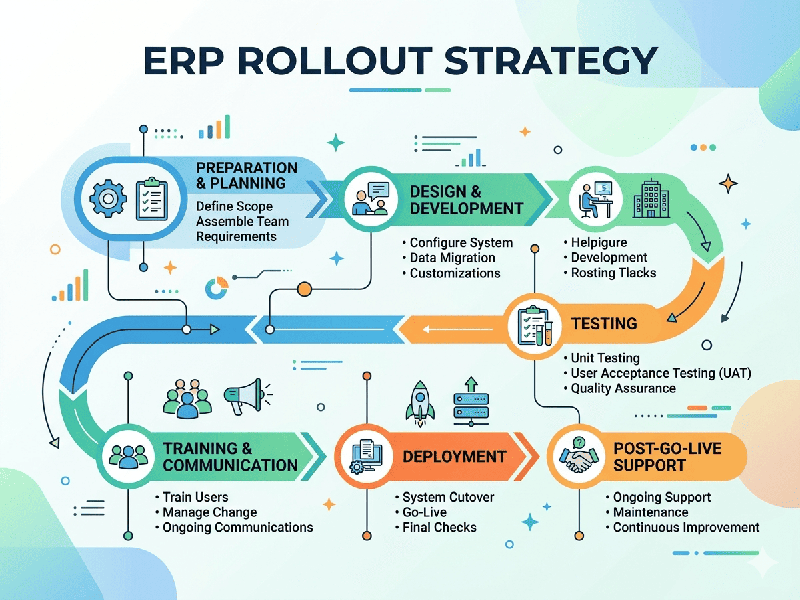
ERP Rollout Strategy
An Enterprise Resource Planning (ERP) rollout is less of an IT project and more of a fundamental organizational transformation. In 2026, the shift toward Cloud-native ERPs and AI-driven data migration has accelerated timelines, but the risk of operational disruption remains high without a structured strategy.
1. The 5-Phase Implementation Lifecycle
Phase 1: Discovery & Process Alignment
Do not automate a broken process.
- Gap Analysis: Identify where the standard ERP
features differ from your current workflows.
- Standardization: Aim for "Vanilla"
implementation where possible. Customization increases costs and makes
future updates difficult.
Phase 2: Data Migration & Cleansing
- Data Audit: Identify redundant, obsolete,
or trivial (ROT) data.
- Mapping: Ensure field logic in the old
system aligns with the new schema.
- Validation: Use automated scripts to verify
data integrity post-migration.
Phase 3: The Build & Configuration
- Sandboxing: Create a non-production
environment for testing.
- Integration: Ensure the ERP communicates
seamlessly with your existing CRM, payroll, and supply chain tools via
APIs.
Phase 4: Training & Change Management
People, not software, determine ERP success.
- Super Users: Train a "champion" in
every department to provide peer-to-peer support.
- Role-Based Training: Don't overwhelm staff; only
train them on the specific modules they will use daily.
Phase 5: Go-Live & Hyper-Care
- The War Room: Establish a dedicated support
desk for the first 30 days to resolve "Tier 1" issues
immediately.
- Post-Mortem: Conduct a review 90 days in to
measure realized ROI against the original business case.
2. Critical Success Factors for 2026
- Mobile-First Accessibility: Ensure the rollout includes a
strategy for field staff and remote workers to access the ERP via mobile
apps.
- Cybersecurity Integration: Apply Zero-Trust
principles to ERP access. Every user and device must be continuously
verified.
- AI & Automation: Leverage built-in AI for
"Predictive Maintenance" in manufacturing or "Automated
Reconciliation" in finance to prove immediate value to stakeholders.
3. Common Pitfalls to Avoid
- Scope Creep: Adding "nice-to-have"
features mid-project that blow the budget and timeline.
- Underestimating Hardware: Even for Cloud ERPs, ensure
your local network bandwidth can handle the increased data traffic.
- Poor Executive Buy-in: If leadership doesn't use the
system for reporting, the rest of the staff won't take it seriously.