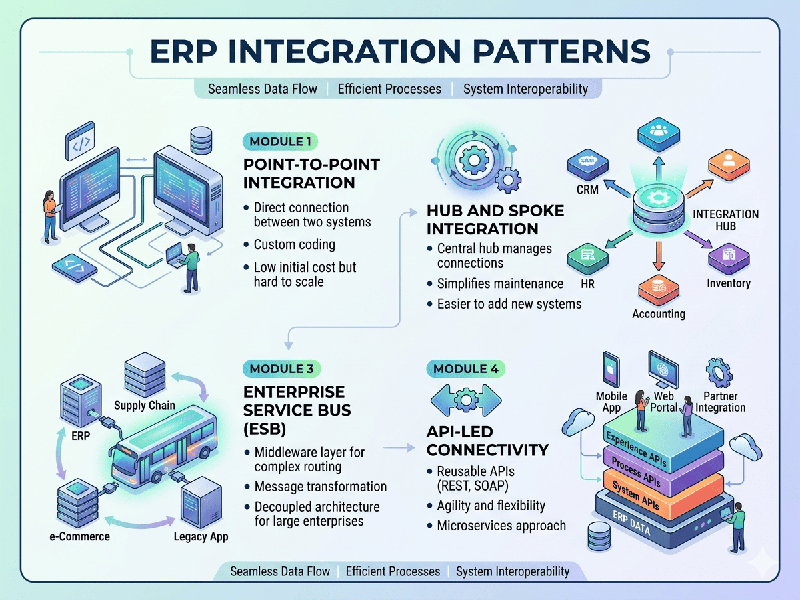
ERP Integration Patterns
Integrating an Enterprise Resource Planning (ERP) system with other applications—like CRM, E-commerce platforms, or specialized logistics software—is critical for eliminating data silos and ensuring a "single source of truth."
1. Point-to-Point (P2P) Integration
The most basic pattern where a custom script or connector
links two systems directly.
- How it works: System A talks directly to
System B (e.g., your E-commerce store sending orders directly to the ERP).
- Best for: Small setups with only two or
three applications.
- The Catch: It is difficult to scale. As
you add more systems, you create a "spaghetti" of connections
that are hard to maintain.
2. Hub-and-Spoke Integration
A centralized "Hub" (often an Integration Platform
or Middleware) manages all traffic between the ERP and external systems (the
"Spokes").
- How it works: Instead of every app talking to
each other, they all talk to the Hub. The Hub handles data transformation
and routing.
- Benefit: If you replace a
"Spoke" (like switching your CRM), you only have to update one
connection at the Hub rather than every individual link.
3. Enterprise Service Bus (ESB)
A more sophisticated, decoupled version of the hub-and-spoke
model, designed for high-volume enterprise environments.
- How it works: The ESB acts as a communication
layer where systems "plug in." It supports complex rules, such
as protocol conversion (e.g., turning a legacy file into a modern API
request).
- Best for: Large-scale digital
transformations involving legacy systems and modern cloud apps.
4. Event-Driven Architecture (EDA)
The modern standard for real-time responsiveness.
- How it works: Instead of "polling"
for data (asking "is there an update?"), the ERP publishes an Event
(e.g., "Item Shipped"). Any system interested in that event
(like a tracking app) "subscribes" and reacts instantly.
- Advantage: Extremely fast and reduces the
load on the ERP database because data is only pushed when something
actually happens.