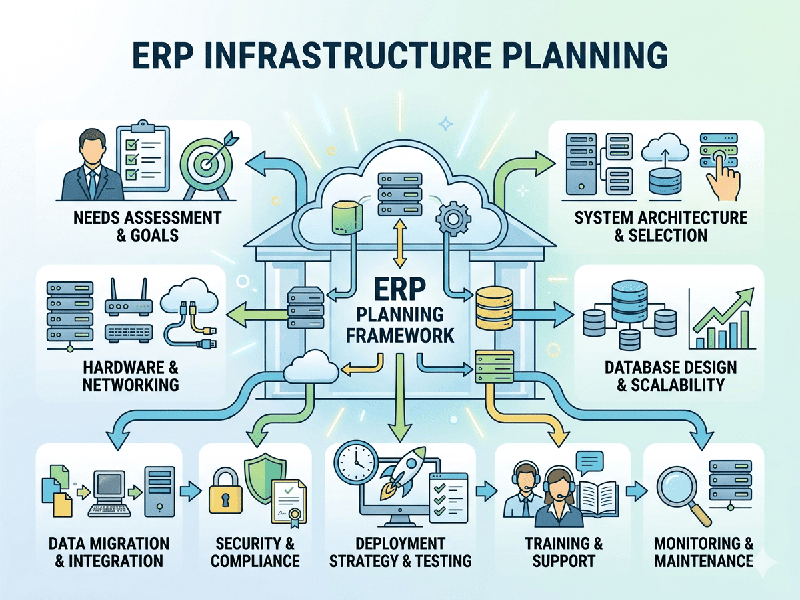
ERP Infrastructure Planning
Planning an ERP (Enterprise Resource Planning)
infrastructure requires a balance between high-speed performance, data
security, and the flexibility to integrate AI-driven modules. Modern ERPs are
no longer just "databases"; they are the central nervous system of a
business.
1. Deployment Models: Cloud vs. Hybrid
The first decision in infrastructure planning is where the
data lives.
- Public Cloud (SaaS): (e.g., SAP S/4HANA Public
Cloud, Oracle NetSuite). Best for rapid scaling and lower upfront costs.
The provider handles security and updates.
- Private Cloud / Single Tenant: Best for companies with strict
regulatory requirements (like RBI mandates in India) that need dedicated
resources and total control over update cycles.
- Hybrid ERP: A "Two-Tier" approach
where the core headquarters uses a robust on-premise system, while
regional offices use a lighter, cloud-based ERP.
2. Core Infrastructure Components
To support a global ERP, your technical stack must meet these
minimum standards:
- Database Layer: Modern ERPs require In-Memory
Computing (like SAP HANA). This allows for real-time analytics instead
of waiting for overnight batch processing.
- Compute Power: High-performance instances with
auto-scaling. If your export volume spikes during a specific season, your
cloud infrastructure (GCP/Azure/AWS) should automatically scale CPU and
RAM.
- Storage Strategy: Use Tiered Storage. Keep
active financial data on high-speed SSDs (Hot storage) and move 5-year-old
audit logs to cheaper, "Cold" storage to optimize costs.
3. Data Governance & Compliance
Infrastructure must be designed around the movement and
protection of data.
- API Management: ERPs must talk to external
systems (Customs, Banking/RBI portals, Logistics providers). Use an API
Gateway to monitor, secure, and throttle these connections.
- Data Residency: Ensure your infrastructure
complies with local laws. For business in India, this means ensuring
financial and personal data is stored on servers located within the
country when required by law.
- Security (Zero Trust): Implement Identity and
Access Management (IAM). No user or device should be trusted by
default, even if they are on the internal office network.
4. Integration & Export Traceability
For businesses involved in international trade and logistics,
the ERP infrastructure must support:
- Blockchain Nodes: Integrating blockchain into the
ERP for "Export Traceability" allows you to track a product from
the factory floor to the international customer with an immutable audit
trail.
- IoT Gateways: If you manage warehouses or
manufacturing, your ERP infrastructure needs a layer to ingest real-time
data from IoT sensors (temperature, location, vibration).