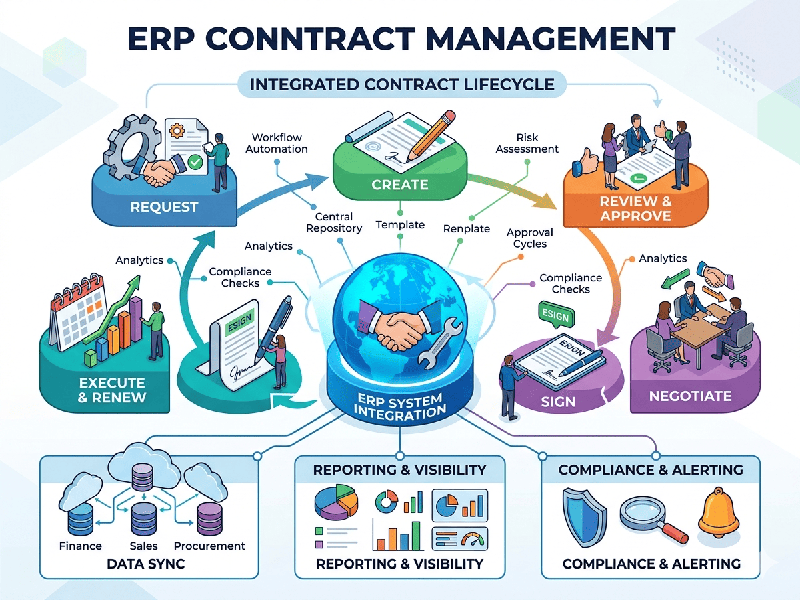
ERP Contract Management
In the landscape of 2026, ERP (Enterprise Resource Planning)
systems have evolved to treat contracts not just as static documents, but as
"living" data points that drive financial and operational automation.
The Operational Efficiency Approach
Best for: Supply chain managers, procurement departments, and logistics-heavy
businesses.
This perspective views ERP Contract Management as a tool to automate
the lifecycle of an agreement to prevent "contract leakage" (lost
savings).
- Automated Procurement: The ERP links contract terms
directly to purchase orders. If a contract specifies a 5% discount
for orders over 1,000 units, the system automatically applies that pricing
without manual entry.
- Milestone Tracking: For complex projects, the ERP
triggers payments only when specific milestones are verified within the
system (e.g., "Goods Received" or "Quality Inspection
Passed").
- Vendor Performance Monitoring: The system compares real-world
delivery data against contract SLAs (Service Level Agreements). If a
vendor is consistently late, the ERP flags the contract for renegotiation
or termination.
- Renewal Alerts: Proactive notifications are
sent 60–90 days before an expiration date, preventing accidental
auto-renewals or lapses in service.