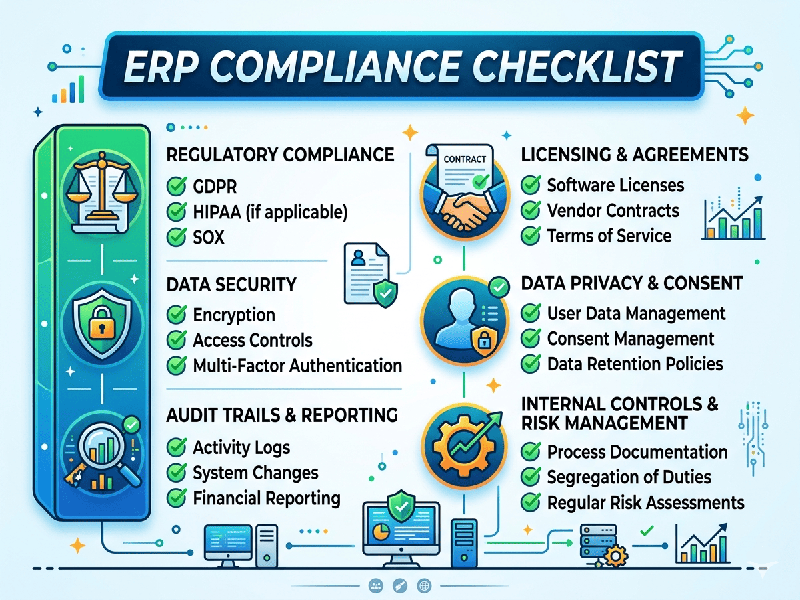
ERP Compliance Checklist
An ERP (Enterprise Resource Planning) compliance checklist in
2026 is no longer a static document; it is a continuous framework that ensures
your business data, financial reporting, and operational workflows meet the
increasingly strict demands of global and local regulators.
For businesses in India, this means aligning with RBI
digital lending guidelines, tax mandates, and international data
privacy laws.
1. Data Privacy & Governance
In 2026, data residency and protection are board-level risks.
Your ERP must act as a fortress for personal and financial information.
- Role-Based Access Control
(RBAC): Ensure
access is restricted by department and seniority. Prevent shared logins to
maintain a clean audit trail.
- Data Minimization: Audit your legacy data to
ensure you aren't storing unnecessary customer or employee records, which
increases legal liability.
- Consent Management: Built-in tracking for user
consent (especially if your ERP integrates with CRM or HR modules) to
comply with GDPR and local privacy laws.
- Encryption Standards: Data must be encrypted both at
rest (in the database) and in transit (during API calls or
remote access).
- Right to Erasure: Automated workflows to identify
and delete specific user data upon request without breaking the integrity
of the overall database.
2. Financial & Tax Compliance
ERP systems must provide real-time accuracy for automated
reporting to avoid the "last-minute scramble."
- Digital Invoicing Mandates: Automatic generation and
reporting of e-invoices directly to government portals (e.g., GSTN in
India).
- Audit Trail Permanence: Every transaction—from a
journal entry to a purchase order—must have an immutable log showing who
created, edited, or approved it.
- Multi-Currency Reconciliation: For exporters, ensuring that
realized and unrealized gains/losses are calculated using real-time
exchange rates.
- EMI & Lending Compliance: If managing internal loans or
credit, ensure workflows follow the 2026 RBI Pre-payment Directions
and show no hidden charges.
- Tax Provisioning: Automated calculation of GST,
TDS, and other local levies based on the latest 2026 tax slabs.
3. Supply Chain & Export Compliance
For businesses involved in international trade, the ERP must
manage the "paper trail" across borders.
- Incoterm Integration: Ensuring that shipping
documents and liability transfers are automatically tagged with the
correct Incoterms.
- Traceability (QR/Blockchain): Every batch of exported goods
should be traceable back to its origin via the ERP to meet "Green
Supply Chain" or sustainability mandates.
- CHA & Agent Management: Digital workflows for Custom
House Agents (CHA) to upload pre-shipment inspections and customs
clearance documents directly into the ERP.
- Sanction Screening: Automated checks against global
"Restricted Party Lists" before finalizing export orders to
prevent accidental trade violations.