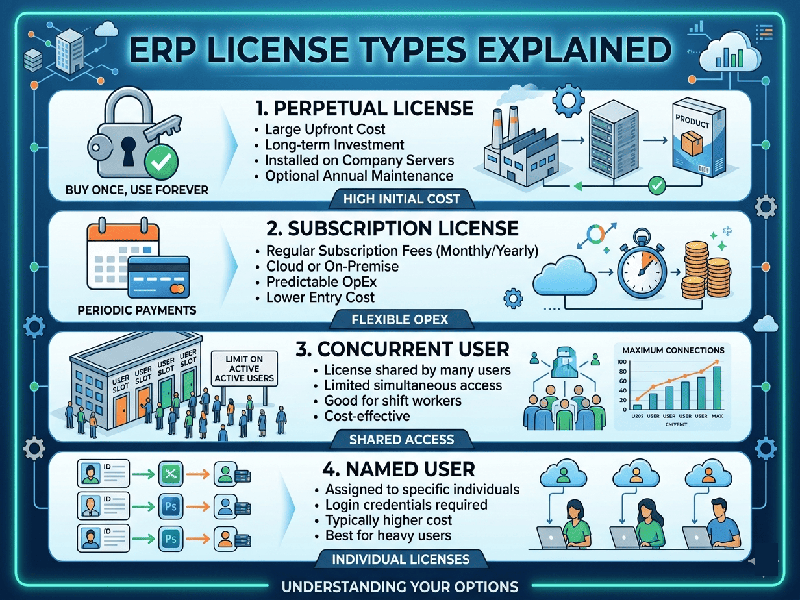
ERP License Types Explained
Enterprise
Resource Planning (ERP) licensing has shifted from simple "per-seat"
models to complex, usage-based structures. Choosing the right one depends on
your organization's size, budget, and how often your team actually interacts
with the software.
1.
User-Based Licensing (The Standard)
This is the
most common model, where you pay for the number of individuals accessing the
system.
- Named User: Each license is assigned to a
specific person (e.g., [email protected]). Even if John doesn't log in
for a week, that license is reserved for him.
- Concurrent User: Licenses are shared. If you
have 50 employees but only 20 are ever logged in at the same time, you
only buy 20 licenses.
- Best for: Shift-based businesses or
global teams in different time zones.
2.
Role-Based (Tiered) Licensing
Not every
employee needs full administrative access. Vendors often break licenses down by
the level of functionality required:
- Full User: Complete access to all modules
(Finance, HR, Supply Chain). Usually for managers and power users.
- Self-Service / Team Member: Limited access for basic tasks
like submitting time sheets, viewing pay stubs, or requesting leave.
- Read-Only: For users who only need to view
reports or data without making changes.
3.
Subscription vs. Perpetual
This defines
how you pay for the software over time.
- SaaS (Subscription): A monthly or annual fee (OpEx).
It includes hosting, updates, and support. This is the modern standard for
Cloud ERPs.
- Perpetual (On-Premise): You pay a large upfront cost
(CapEx) to "own" the software indefinitely. However, you usually
pay an additional 15-25% annually for maintenance and updates.
4.
Usage-Based / Transactional Licensing
A newer
model gaining popularity with Cloud ERPs. Instead of counting heads, the vendor
charges based on the volume of activity.
- Metrics: Number of invoices processed,
total revenue managed, or number of warehouse shipments.
- Pro: Scales perfectly with your
business growth.
- Con: Costs can be unpredictable
during peak seasons.
5. Site
or Enterprise Licensing
For very
large organizations, a "Site License" provides unlimited access for
everyone at a specific location or across the entire corporation for a flat,
negotiated fee.