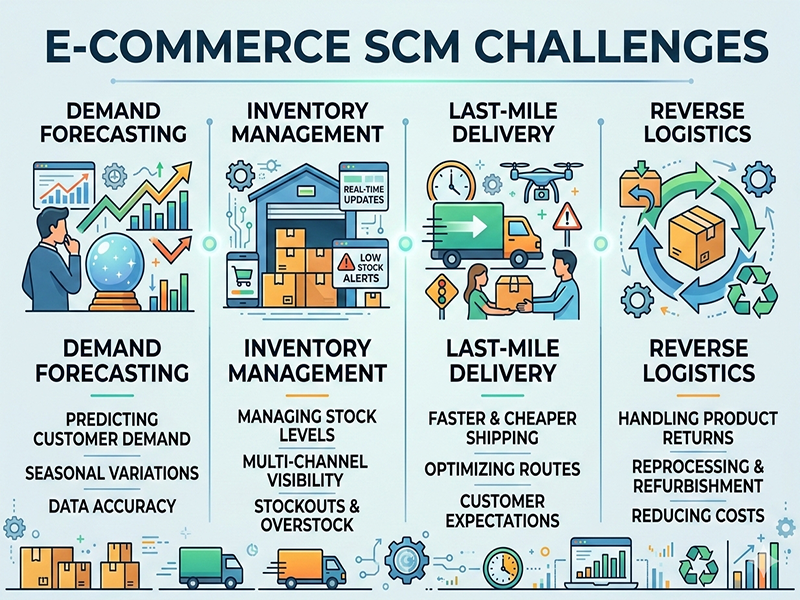
E-commerce SCM Challenges
The
e-commerce landscape in 2026 is defined by a shift from "speed at all
costs" to "resilient, sustainable, and AI-driven operations." As
global trade becomes more volatile and consumer expectations reach new heights,
supply chain management (SCM) faces a unique set of modern hurdles.
1. The
"Last-Mile" Efficiency Gap
The last
mile remains the most expensive and complex part of the journey, often
accounting for up to 50% of total shipping costs.
- The Challenge: Customers now expect
"instant" (sub-2-hour or same-day) delivery as a standard, not a
luxury. In urban areas, congestion and parking restrictions hamper speed;
in rural areas, "empty miles" (driving long distances for a
single drop-off) tank profitability.
- 2026 Shift: Companies are moving toward hyper-local
micro-fulfillment centers—small warehouses located within city
limits—to bridge the gap.
2.
Inventory Imbalance & Demand Volatility
Traditional
forecasting is struggling to keep up with "social commerce" trends
that can cause a product to sell out in hours.
- The Challenge: Overstocking leads to high
storage costs and "markdown pressure," while stockouts lead to
customer churn. With 2026's volatile inflation and shifting consumer
habits, "gut feeling" planning is obsolete.
- The Solution: AI-driven "Predictive
Commerce." Using real-time data from social media, weather
patterns, and even "shopping agents" (AI bots that buy on behalf
of humans) to adjust stock levels dynamically.
3. The
"Reverse Logistics" Nightmare
Returns are
no longer just a "back-office" problem; they are a major
margin-killer.
- The Challenge: In categories like apparel,
return rates can exceed 30%. Processing these returns (inspecting,
cleaning, and restocking) often costs more than the item is worth.
- The 2026 Trend: The rise of re-commerce.
Instead of just returning items, platforms are integrating peer-to-peer
resale or "circular" loops where returned goods are refurbished
and sold locally to reduce the "reverse mile" carbon footprint.
4.
Sustainability & Regulatory Compliance
In 2026,
"greenwashing" is a legal risk. New regulations (like the CSDDD in
Europe) mandate transparency across the entire supply chain.
- Scope 3 Emissions: Companies are now responsible
for the carbon footprint of their suppliers and delivery
partners, not just their own warehouses.
- Packaging Pressure: There is a massive push to
eliminate "air" in boxes and move toward 100% compostable or
reusable packaging systems.
5.
Geopolitical "Global Gridlock"
Tariff
volatility and regional conflicts have made long-distance sourcing a gamble.
- The Challenge: Sudden duty changes or shipping
lane closures (e.g., in the Mideast or South China Sea) can change the
"landed cost" of a product overnight.
- Strategic Pivot: Nearshoring and
Friend-shoring. Many e-commerce giants are moving production closer to
their primary markets (e.g., US companies sourcing from Mexico) to reduce
lead times and exposure to global shocks.