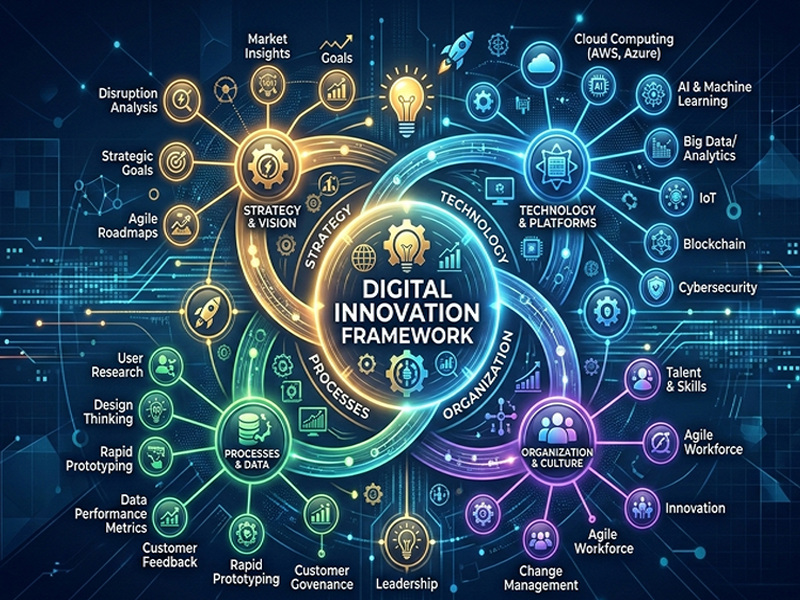
Digital Innovation Frameworks
Digital
Innovation Frameworks are the strategic blueprints organizations use to
integrate technology into their business models, products, and processes.
Rather than just "buying new software," these frameworks help
companies reinvent how they deliver value.
1. The
Three Horizons Model (McKinsey)
This is the
gold standard for balancing "keeping the lights on" with
"inventing the future." It ensures a company doesn't go extinct by
focusing too much on today.
- Horizon 1: Incremental innovation to the
core business (e.g., improving current software).
- Horizon 2: Emerging opportunities or
business extensions (e.g., launching a new digital service line).
- Horizon 3: Creating genuinely disruptive
new businesses (e.g., exploring AI or blockchain before they become
mainstream).
2. Design
Thinking (Stanford d.school)
This is a human-centric
framework. It’s less about the technology and more about solving a specific
user pain point.
- Empathize: Research your users' needs.
- Define: State the users' needs and
problems.
- Ideate: Challenge assumptions and
create ideas.
- Prototype: Start creating solutions.
- Test: Try your solutions out.
3. The
Lean Startup Framework (Eric Ries)
Popularized
in Silicon Valley, this framework focuses on speed and "validated
learning." It’s designed to prevent companies from building expensive
products that nobody actually wants.
- Build: Create a Minimum Viable Product
(MVP).
- Measure: See how customers actually use
it.
- Learn: Decide whether to pivot
(change direction) or persevere (keep going).