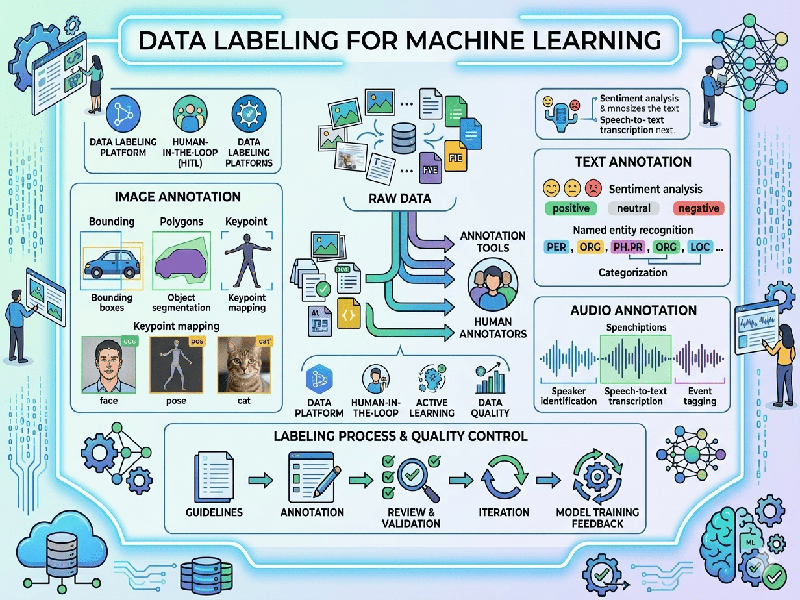
Data Labeling for ML
Data
labeling has evolved from a manual "click-and-drag" chore into a
sophisticated human-in-the-loop (HITL) orchestration. With the explosion
of specialized AI models, the focus has shifted from quantity to high-fidelity,
multi-modal precision.
1. Modern
Labeling Techniques
Programmatic
Labeling (Snorkel Style)
Instead of
labeling 10,000 images manually, data scientists write labeling functions.
These are small scripts or rules that automatically tag data. A weak
supervision model then resolves conflicts between different rules to create a
"ground truth" dataset.
- Benefit: Highly scalable and keeps data
private (no need for external contractors to see sensitive files).
Active
Learning
The model
"chooses" which data it's unsure about and sends only those
specific examples to a human for labeling.
- Workflow: Model trains on a small set $\rightarrow$
Model identifies "uncertain" data $\rightarrow$ Human labels the
uncertain data $\rightarrow$ Model retrains.
Synthetic
Data Labeling
In 2026, we
often use "Teacher Models" (massive LLMs or Vision models) to
generate and label synthetic data for smaller "Student Models." Since
the data is computer-generated, the labels are pixel-perfect by default.
3. The
Quality Assurance (QA) Layer
Labels are
only useful if they are accurate. Modern pipelines use several consensus
methods:
- Consensus (Overlap): Three different people label
the same image. If they all agree, the label is accepted.
- Gold Standard: Occasional "test"
images with known correct labels are hidden in the workflow to check if a
human labeler is paying attention.
- Inter-Rater Reliability (IRR): A mathematical score (like
Cohen’s Kappa) used to measure how much agreement exists between different
labelers.
4. Key
Trends in 2026
- RLHF (Reinforcement Learning
from Human Feedback): This is the "gold standard" for tuning LLMs. Humans rank
different AI responses from "best" to "worst,"
teaching the model nuance, tone, and safety.
- Edge Labeling: Labeling data directly
on-device (like a smartphone or IoT sensor) to maintain privacy and reduce
cloud costs.
- Specialized Domain Labeling: A move away from general
crowdsourcing toward hiring SMEs (Subject Matter Experts)—like
doctors for medical AI or lawyers for legal AI—to ensure technical
accuracy.
5.
Leading Platforms
- Scale AI / Labelbox: High-end enterprise platforms
with heavy automation.
- Amazon SageMaker Ground Truth: Integrated directly into the
AWS ecosystem.
- Argilla: An increasingly popular
open-source tool for data-centric NLP.