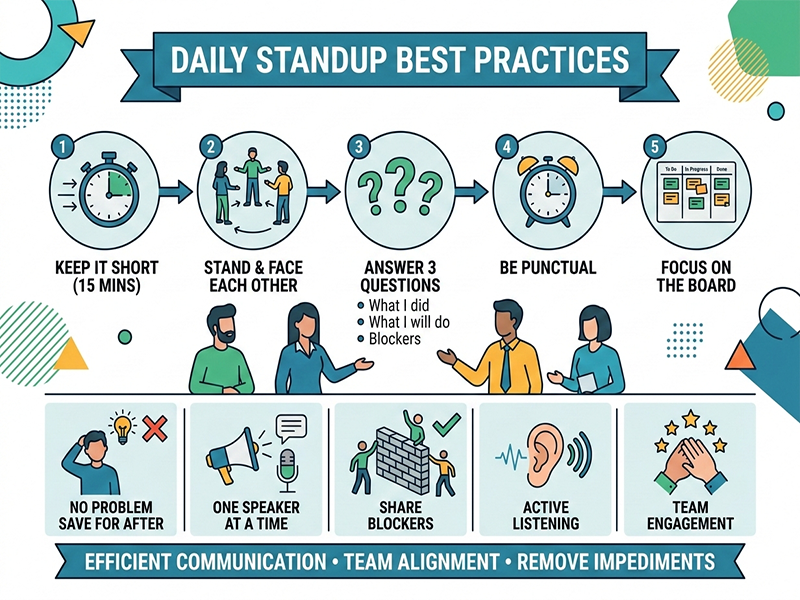
Daily Standup Best Practices
A Daily Standup (or "Daily Scrum") is meant to be a quick pulse check, not a status report to a boss. In 2026, with hybrid and remote work being the standard, the goal is to maximize alignment and minimize "zoom fatigue."
1. The Logistics: Short & Consistent
- The 15-Minute Rule: If it goes longer, you’re
problem-solving, not syncing. Move deep dives to a separate "parking
lot" meeting.
- Same Time, Same Place: Consistency reduces cognitive
load.
- Stand Up (Literally): If you are in person, actually
standing keeps the meeting uncomfortable enough that people don't ramble.
2. The
"Three Questions" (Evolved)
The
traditional questions can get repetitive. Try this slightly more
"active" version to focus on outcomes rather than just
"busy work":
1.
Goal Progress:
"What did I do yesterday that helped us hit the Sprint Goal?"
2.
Today’s Focus:
"What am I doing today to move the needle?"
3.
The Roadblock:
"Are there any 'blockers' (technical, personal, or third-party) stopping
me?"
3.
Execution Best Practices
- Walk the Board: Instead of going
person-by-person, look at the Task Board (Jira/Linear). Start from the
"Done" column and move left to see what’s stuck. This focuses on
the work, not the person.
- The "Parking Lot": When someone says, "Oh, we
should talk about that API change," the moderator says: "Parking
lot!" This means: hold that thought until the 15 minutes are up.
- Pass the Torch: Don't have a manager call on
people. Have the current speaker pick the next person. It keeps everyone
paying attention.
- End with a "Social
Spark": In
remote teams, spend the last 60 seconds on something non-work (e.g.,
"What's for lunch?") to maintain human connection.