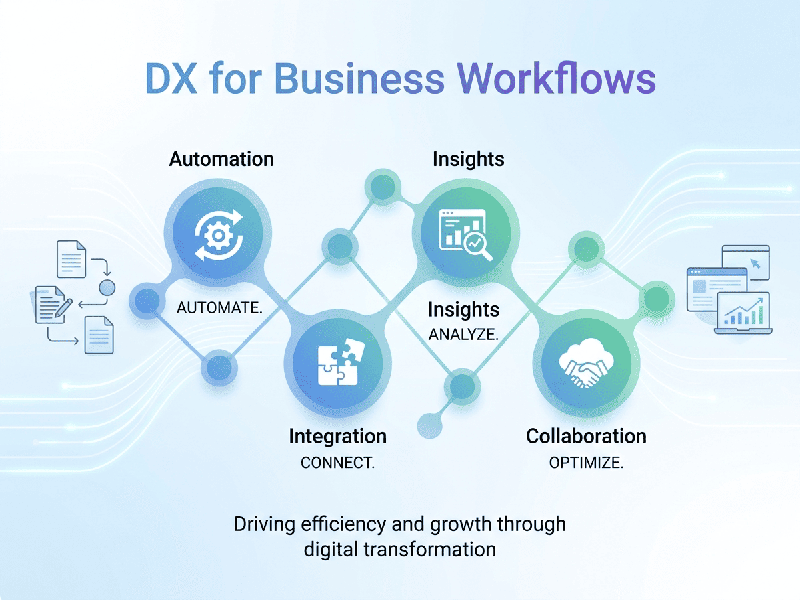
DX for Business Workflows
Integrating Digital Transformation (DX) into business
workflows is about more than just "going digital"; it’s about
redesigning processes to be agile, data-driven, and automated. Below is a
breakdown of how DX reshapes modern operations.
1. Core Pillars of Workflow DX
To effectively transform a workflow, businesses generally
focus on these four technological layers:
- Process Automation (RPA): Using software "bots"
to handle repetitive, manual tasks like data entry, invoice processing, or
standard reporting.
- Data Integration &
Centralization:
Breaking down silos so that information flows seamlessly between
departments (e.g., Sales, Finance, and Logistics) via APIs or ERP systems.
- AI & Machine Learning: Moving from reactive to
predictive workflows. This includes using AI for lead scoring, demand
forecasting, or automated customer support.
- Cloud Infrastructure: Transitioning to the cloud to
ensure scalability, remote accessibility, and real-time collaboration.
2. Key Workflow Transformations
A. Sales and Lead Management
DX replaces manual tracking with automated funnels.
- The Shift: Instead of spreadsheets, CRM
systems automatically capture leads from web forms, use AI to rank them by
"readiness to buy," and trigger personalized email sequences.
- The Result: Faster response times and
higher conversion rates.
B. Supply Chain and Logistics
DX introduces transparency into complex global movements.
- The Shift: Implementing IoT sensors and
blockchain for real-time tracking. Digital workflows can automatically
generate shipping documents and alert stakeholders of customs delays.
- The Result: Reduced lead times and better
inventory management.
C. Financial Operations
Transforming debt management and lending through automation.
- The Shift: Using automated credit scoring
models that analyze alternative data points in seconds. Workflows for EMI
collections can be automated with smart reminders and personalized
refinancing options.
- The Result: Improved cash flow and lower
default rates.
3. Implementation Roadmap
1.
Audit the Current State: Identify "bottlenecks"—tasks that take the longest
or have the highest error rates.
2.
Define ROI Metrics: Determine what success looks like. Is it a 20% reduction in processing
time or a ₹500,000 saving in operational costs?
3.
Choose the Tech Stack: Select tools that offer high interoperability (they
"talk" to each other).
4.
Iterative Deployment: Start with a pilot program in one department before scaling across the
entire organization.
4. Overcoming DX Challenges
- Legacy Systems: Old software often doesn't
integrate well. The solution is often a "middleware" layer or a
gradual migration to cloud-native apps.
- Cultural Resistance: DX requires a mindset shift.
Success depends on training teams to view AI and automation as tools that
augment their work, rather than replace it.
- Cost Management: Cloud costs can spiral if not
monitored. Strategies like using Reserved Instances or setting strict API
rate limits are essential for maintaining a healthy bottom line.