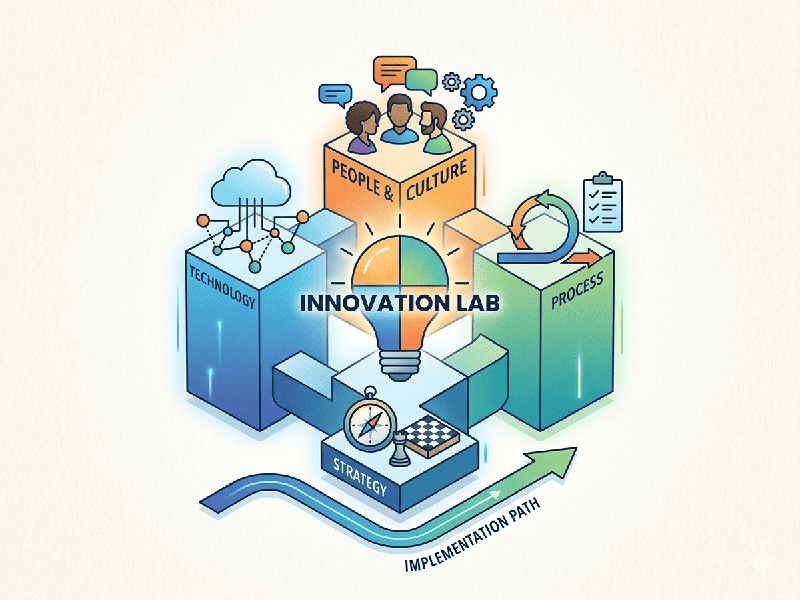
Creating a DX Innovation Lab
Establishing a Digital Transformation (DX) Innovation Lab
is a strategic move to insulate "future-thinking" from the daily
operational grind. It serves as a sandbox for testing emerging technologies
like AI, IoT, and Cloud without risking core business stability.
1. Core Mission & Objectives
Before hiring or buying hardware, define what
"innovation" means for your organization.
- Rapid Prototyping: Moving from idea to Minimum
Viable Product (MVP) in weeks, not months.
- Technology Scouting: Identifying emerging tech
(e.g., Generative AI, Edge Computing) that could disrupt your industry.
- Culture Shifting: Acting as an internal agency to
teach "Agile" and "Design Thinking" to traditional
departments.
2. The Organizational Structure
A lab needs to be connected to the Mothership but independent
enough to take risks.
- Governance: Ideally, the lab reports
directly to the CDO (Chief Digital Officer) or CEO to bypass
middle-management "innovation killers."
- Funding: Use a "Venture
Capital" model. Fund the lab for 12–18 months upfront rather than
requiring a traditional ROI for every small experiment.
3. Operational Workflow
1.
Ideation:
Crowdsource "pain points" from business units.
2.
Feasibility Study: Can we build it? Does the data exist?
3.
Sprints:
2-week cycles to build a functional prototype.
4.
The "Kill" or "Scale" Decision: If the prototype fails, harvest the
learnings and move on. If it succeeds, create a transition plan to hand it over
to the IT or Operations team.
4. Critical Success Factors
- Psychological Safety: You must celebrate "smart
failures." If the lab is afraid to fail, it will only produce
incremental updates, not true innovation.
- Data Accessibility: Ensure the lab has a "Data
Sandbox"—a cleaned, anonymized version of company data to train
models without security risks.
- KPIs vs. OKRs: Don’t measure the lab on
"Revenue Generated" in Year 1. Measure it on "Velocity
of Learning" and "Number of Validated Prototypes."