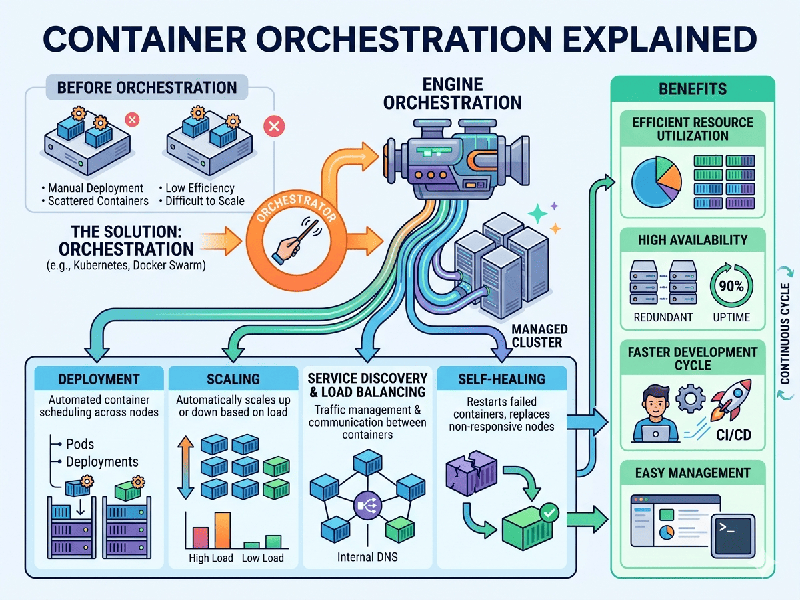
Container Orchestration Explained
Container
orchestration is the automated process of managing the lifecycle of software
containers in complex, dynamic environments. If a container is a single
performer, orchestration is the conductor ensuring the entire symphony
plays in harmony.
In a modern
microservices architecture, you might have hundreds or thousands of containers.
Managing them manually—starting, stopping, and networking them—is impossible at
scale.
The Core
Functions of Orchestration
An
orchestration platform (like Kubernetes or Docker Swarm) handles the
"heavy lifting" of operations:
- Provisioning & Deployment: Automatically pulling container
images and starting them on available hardware.
- Resource Allocation: Placing containers on the
best-suited servers based on available CPU and RAM.
- Scaling: Increasing or decreasing the
number of container instances based on traffic spikes or dips.
- Load Balancing: Distributing incoming web
traffic across multiple healthy containers to prevent any single one from
crashing.
- Self-Healing: If a container fails, the
orchestrator detects it and immediately restarts a new one to maintain the
"desired state."
- Service Discovery: Providing a stable internal DNS
so that different containers (e.g., a "Payment" service and a
"Cart" service) can find and talk to each other.
How It
Works: The "Desired State" Model
Orchestration
typically operates on a declarative model. Instead of telling the system
how to do something, you tell it what you want the final result
to be.
1.
The Configuration: You provide a YAML or JSON file stating: "I want 5 copies of the
'Billing' container running on Port 80."
2.
The Control Plane: The orchestrator reads this and checks the current status of the
cluster.
3.
The Reconciliation Loop: If it sees only 2 containers running, it automatically
triggers the deployment of 3 more to match your request.