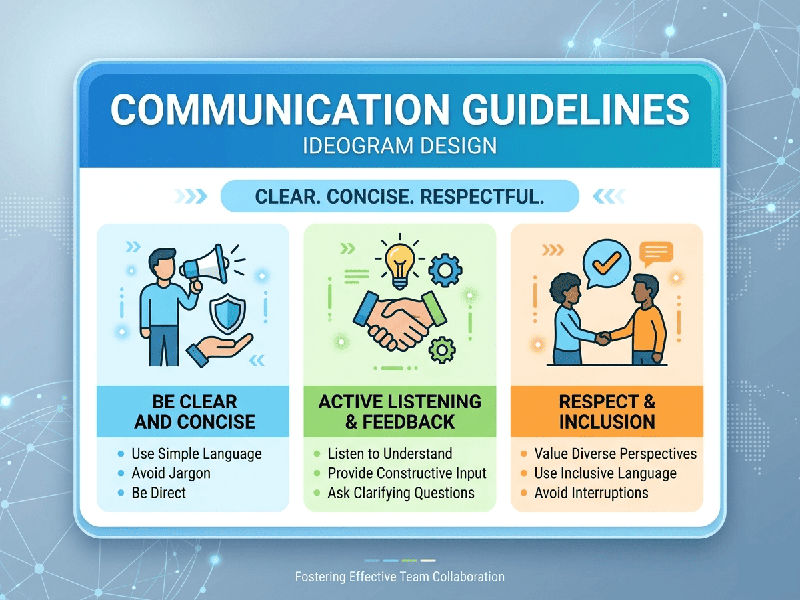
Communication Guidelines
Communication guidelines serve as the "operating
system" for an organization's internal and external interactions. In 2026,
with the rise of asynchronous work and AI-augmented messaging,
these guidelines are essential to prevent digital fatigue and ensure clarity.
1. The Core Philosophy: "Signal vs. Noise"
Every communication should pass the Signal Test before
it is sent.
- Is it necessary? Could this be a shared document
update instead of an email?
- Is it urgent? Does it require a 10-minute
response or a 24-hour response?
- Is it clear? Does the recipient know exactly
what action is required of them?
2. Best Practices for Digital Etiquette
A. The "Action-Oriented" Subject Line
Never send an email or message with a vague subject like
"Question" or "Update."
- Bad: Project Update
- Good: [ACTION REQUIRED] Approval for
Q3 Marketing Budget by Friday
B. The 2-Minute Rule for Slack/Teams
If a conversation on a messaging app lasts more than 2
minutes without a resolution, move to a huddle or call. Text is poor for
nuance and often leads to unnecessary back-and-forth.
C. Default to Asynchronous
Respect "Deep Work" hours. Before tagging someone
or calling them, check their calendar and status. Use scheduled send
features to avoid hitting colleagues' inboxes during their off-hours or
weekends.
3. Visual and Structural Clarity
To ensure your message is actually read, follow these
formatting rules:
- BLUF (Bottom Line Up Front): Put your main point or request
in the first two sentences.
- Bullet Points: Use them for lists and data to
make the text scannable.
- Bold for Emphasis: Highlight deadlines or key
names so they pop during a quick scroll.
4. AI-Augmented Communication
In 2026, many teams use AI to draft or summarize messages.
These guidelines should include:
- Human Verification: Always review AI-generated
summaries for "hallucinations" or incorrect dates.
- Transparency: If a long meeting was
summarized by an AI bot, label it as such so others know it's a condensed
version.
- Tone Check: Use AI to ensure a message
doesn't sound accidentally aggressive, especially when communicating
across different cultures.
5. Feedback Loops
Communication is a two-way street. Establish a "Feedback
Culture" where:
1.
Acknowledge Receipts: A simple "Got it, looking into this" prevents the sender from
wondering if the message was seen.
2.
Constructive Criticism: Use the "Praise in Public, Correct in Private"
rule.
3.
The "Camera-On" Policy: Define when cameras are expected (e.g., client meetings)
versus when they are optional (e.g., internal stand-ups) to reduce "Zoom
fatigue."