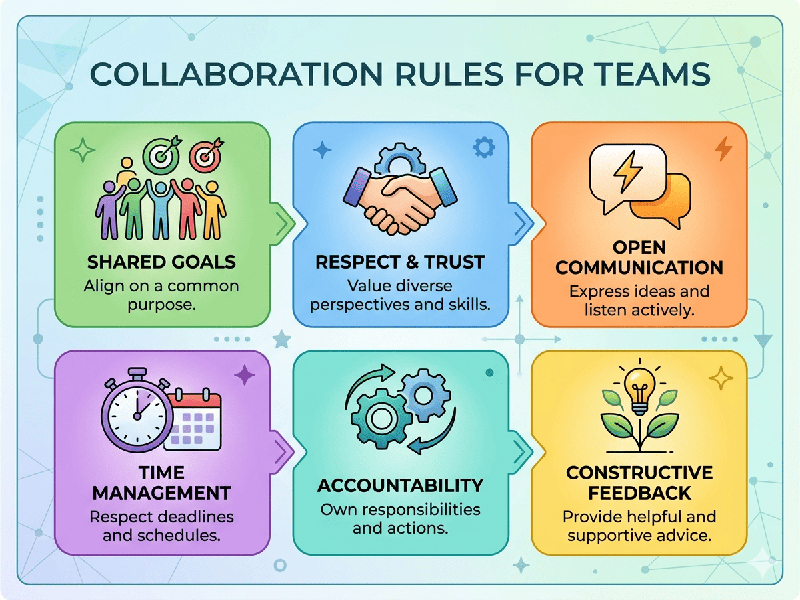
Collaboration Rules for Teams
Establishing clear collaboration rules is essential for
maintaining momentum, reducing friction, and ensuring everyone stays aligned.
Effective team "ground rules" usually fall into four key pillars:
communication, meeting etiquette, decision-making, and accountability.
1. Communication Channels & Response Times
Defining where and when to talk prevents
notification fatigue and information silos.
- Urgency Levels: Use Instant Messaging
(Slack/Teams) for quick questions, Email for formal updates/external
comms, and Project Management tools (Asana/Jira) for task-specific
updates.
- The "4-Hour" Rule: Set a standard for internal
response times (e.g., acknowledge messages within 4 business hours, even
if a full answer isn't ready).
- Status Transparency: Use "Away" or
"Deep Work" statuses to signal when you are unavailable for
ad-hoc pings.
2. Meeting Etiquette
To avoid "meeting burnout," every gathering should
serve a definitive purpose.
- No Agenda, No Attendance: Every meeting must have a clear
objective and agenda sent at least 24 hours in advance.
- Default to Async: If an update can be shared via
a recorded loom or a status document, cancel the meeting.
- Action-Oriented Closures: Every meeting must end with a
summary of Who, What, and When regarding next steps.
3. Feedback and Conflict Resolution
Psychological safety is the backbone of high-performing
teams.
- Criticize the Work, Not the
Person: Focus
feedback on the output or the process rather than individual traits.
- The 24-Hour Rule for Conflict: If a disagreement gets heated,
wait 24 hours before responding to allow for a logical rather than
emotional discussion.
- Directness Over Diplomacy: Encourage "radical
candor"—being clear and direct while still being deeply supportive.
4. Documentation & Knowledge Sharing
Institutional knowledge shouldn't live in people's heads.
- Single Source of Truth: Decide on one platform where
all final documents and project plans live.
- Public by Default: Keep project-related
discussions in public channels rather than private DMs so others can learn
from the context.
- Standardized Naming: Use a consistent naming
convention for files (e.g., YYYYMMDD_ProjectName_V01) to ensure version
control.
5. Decision-Making Frameworks
Clarity on who "pulls the trigger" prevents
bottlenecks.
- DACI or RACI Models: Clearly define who is Driving,
Approving, Contributing, and Informed for every major
milestone.
- Consent vs. Consensus: Don't wait for everyone to
agree 100%. Aim for "consent"—where no one has a principled
objection to moving forward.