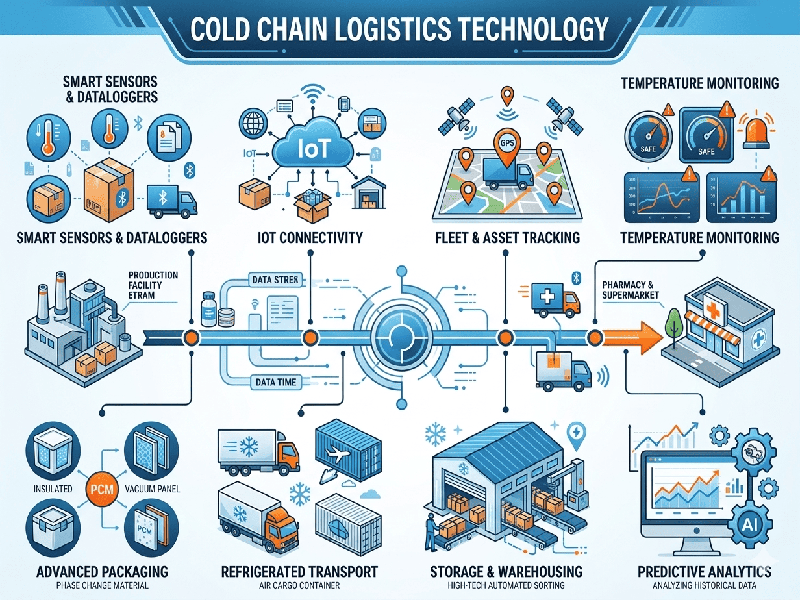
Cold Chain Logistics Technology
Cold chain
logistics has moved from "reactive monitoring" to predictive,
self-correcting ecosystems. Driven by stricter global regulations (like the
EU's updated food safety standards) and the surge in e-commerce, the technology
now focuses on eliminating human error and energy waste.
1.
Ambient & Agentic IoT
We have
moved beyond simple GPS trackers. In 2026, Ambient IoT uses low-cost,
battery-free digital tags on individual items to provide a continuous stream of
data.
- Multi-Sensor Probes: Modern tags monitor more than
just temperature; they track humidity, $O_2$ levels, CO2, and even ethylene
gas (to predict fruit ripening/spoilage).
- Agentic AI Response: If a sensor detects a
temperature spike in a reefer container, "Agentic AI" doesn't
just send an alert—it can independently trigger a command to the
refrigeration unit to lower the temp or reroute the vehicle to a closer
micro-fulfillment center.
2.
Predictive Thermal Analytics (Digital Twins)
Logistics
providers now use Digital Twins—virtual replicas of the physical cold
chain—to run simulations.
- Risk Forecasting: AI analyzes weather patterns,
port congestion, and even solar intensity to predict if a container's
insulation will hold during a 3-day delay in a heatwave.
- Dynamic Slotting: In warehouses, AI optimizes
where pallets are placed based on their thermal sensitivity and
"velocity" (how fast they need to ship out), reducing the time
doors stay open.
3.
Sustainable "Green" Cooling
With energy
costs rising and 2026 carbon regulations in full effect, the physical cooling
tech has evolved:
- Phase Change Materials (PCM): These "thermal
batteries" absorb and release energy to maintain a constant
temperature without requiring constant electricity. They are now standard
for last-mile "e-grocery" deliveries.
- Solar-Electric Reefers: New transport units use
high-efficiency solar films on the roof to power the refrigeration,
allowing the truck's engine to focus solely on driving—or allowing
electric trucks to maintain range.
- Low-GWP Refrigerants: A total shift toward natural
refrigerants (like $CO_2$ or Ammonia) to comply with new environmental
mandates.
4.
Blockchain-Enabled "Trust-as-a-Service"
Data
credibility is the new gold. Blockchain is no longer a buzzword; it’s the ledger
of record for high-stakes goods like pharmaceuticals and specialty
organics.
- Smart Contracts: When a sensor logs a
temperature breach that exceeds the "safety threshold" defined
in a contract, the blockchain can automatically trigger an insurance claim
or pause payment to the carrier.
- Machine-Verifiable Audits: Regulators can verify the
entire "thermal history" of a vaccine or meat shipment in
seconds, replacing manual logbooks that were prone to "fudging."
5.
Quick-Commerce Infrastructure
To support
15-minute deliveries of frozen goods, the industry is deploying:
- Flash-Freezing Chambers: On-demand units that rapidly
condition small stock-keeping units (SKUs) for immediate transport.
- Pre-Conditioned Gear: Delivery personnel now use
smart cooling vests and mini-refrigerated backpacks to maintain the
"ultra-short" cold chain during the final mile.