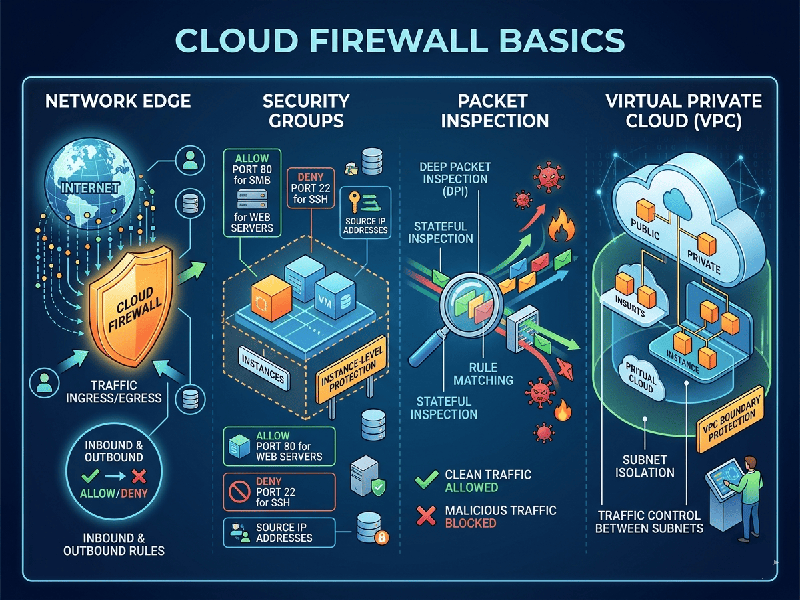
Cloud Firewall Basics
A Cloud Firewall (also known as Firewall-as-a-Service
or FWaaS) is a virtualized security barrier that protects your cloud
infrastructure, applications, and data from cyber threats. Unlike traditional
hardware firewalls that sit in a physical office, a cloud firewall lives on the
internet, scaling automatically as your traffic grows.
1. How It Works: The "Virtual Gatekeeper"
In a traditional setup, traffic is funneled through a
physical box. In a cloud setup, your firewall is a software-defined layer that
intercepts every data packet traveling to or from your cloud resources (like
AWS, Azure, or GCP).
- Inspection: It checks the
"header" (where the data is from) and the "payload"
(what the data is actually carrying).
- Filtering: It applies a set of rules
(e.g., "Only allow traffic from Indian IP addresses to the admin
portal").
- Action: It either allows, blocks, or
flags the traffic for further review.
2. Key Features
Modern cloud firewalls have evolved beyond simple
"block/allow" rules to include intelligent, identity-aware features:
- Deep Packet Inspection (DPI): It doesn't just look at the
label on the package; it opens the package to look for hidden malware or
ransomware signatures.
- Zero Trust Access (ZTNA): It assumes no one is safe by
default. It requires continuous identity verification, even for users
already "inside" the network.
- Micro-segmentation: It allows you to wall off
specific parts of your network from each other. If one web server is
hacked, the firewall prevents the attacker from moving
"laterally" into your database.
- AI-Driven Threat Detection: It uses machine learning to
spot "anomalous" behavior—like a user suddenly downloading 50GB
of data at 3:00 AM—and blocks it automatically.