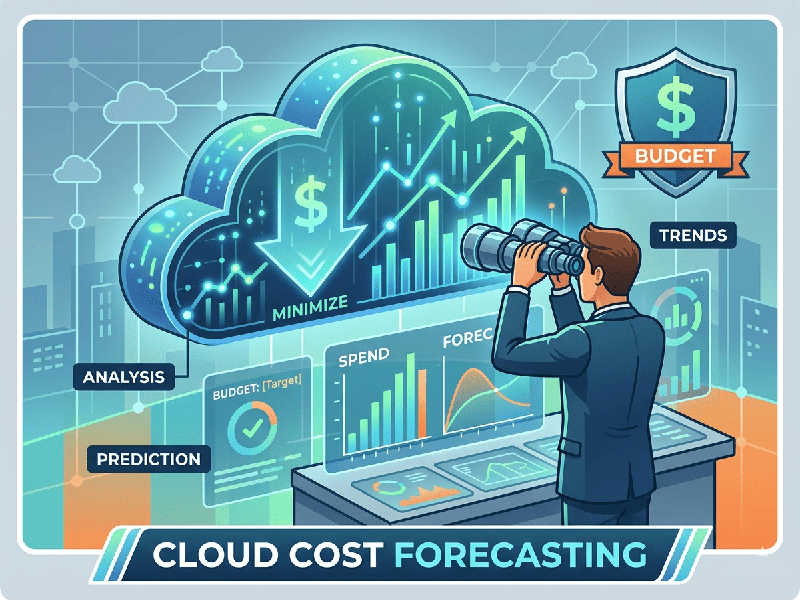
Cloud Cost Forecasting
Cloud cost forecasting has evolved from simple historical
trend lines into a sophisticated discipline involving machine learning and
real-time operational data. In 2026, the goal is to move from
"reactive" budgeting to "predictive" planning.
1. Primary Methods of Forecasting
To build an accurate forecast, organizations typically blend
three distinct analytical approaches:
- Naive/Time-Series Analysis: The most basic method, which
uses historical data to project future spend. It is effective for stable
workloads but often misses sudden spikes or new project launches.
- AI-Driven Predictive Modeling: Modern FinOps tools now use ML
algorithms to analyze past usage, detect seasonal patterns (like month-end
processing or holiday traffic), and self-adjust as workload patterns
change.
- Scenario-Based
("What-If") Modeling: This involves manually inputting planned business
changes—such as a new product launch, a migration from AWS to Azure, or a
20% increase in user traffic—to see the projected cost impact before it
occurs.
2. The Multi-Cloud Challenge
Forecasting across multiple providers (AWS, GCP, Azure)
requires data normalization. Each provider uses different billing
cycles, credit systems, and terminology.
- AWS: Focuses on Cost Explorer
and Savings Plans.
- Azure: Uses Cost Management +
Billing with a focus on Enterprise Agreements.
- GCP: Offers Billing Reports
with strong native anomaly detection.
Key Strategy: Use a centralized FinOps platform to aggregate these diverse
APIs into a single view, ensuring your forecast accounts for cross-cloud data
egress fees, which are often the most difficult "hidden" costs to
predict.
3. Operational Guardrails
To keep forecasts accurate, consider these
infrastructure-level controls:
1.
Automated Rightsizing: Continuously adjust instance sizes based on actual
utilization (CPU/Memory) so the forecast reflects optimized usage, not
"provisioned waste."
2.
API Rate Limiting: Implement strict limits on high-cost API calls to prevent unpredictable
cost surges that could invalidate a monthly forecast.
3.
Scheduled Shutdowns: Automatically turn off non-production environments outside of business
hours. This creates a "predictable dip" in your cost curve.
4.
Tag-Based Budgets: Set specific ₹ (Rupee) thresholds for individual departments. If
a team's spend exceeds the forecast by a certain percentage, trigger an
automated alert to the department head.