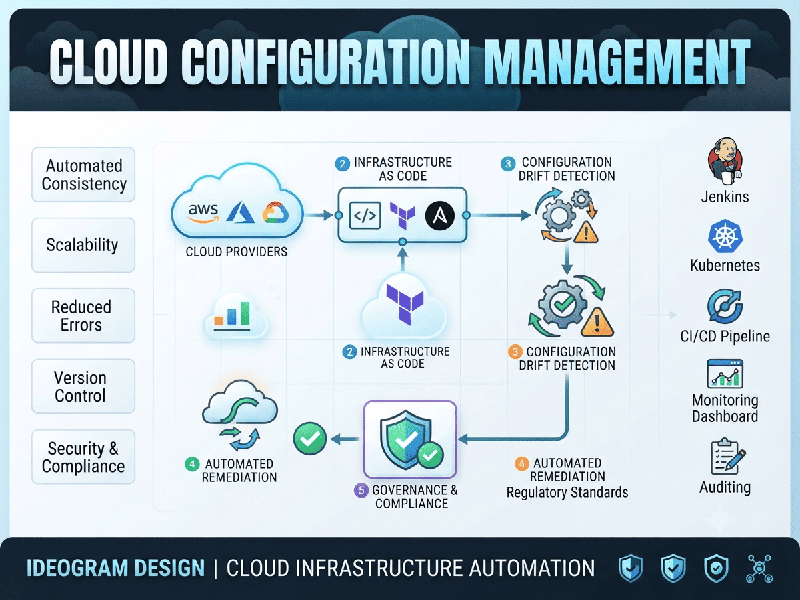
Cloud Configuration Management
Cloud Configuration Management (CCM) is the practice of systematically
managing and maintaining the settings, infrastructure, and software
environments in the cloud. It ensures that your cloud resources—such as virtual
machines, databases, networks, and storage—are deployed in a secure, consistent,
and scalable manner.
Rather than configuring resources manually through a
web console (which is error-prone and hard to track), CCM relies on Infrastructure
as Code (IaC), where environments are defined, provisioned, and updated
using machine-readable configuration files.
Key Pillars of Cloud Configuration
- Consistency &
Standardisation:
Ensures that development, staging, and production environments are
identical, eliminating the "it works on my machine" problem.
- Version Control: By storing configurations in
code (e.g., Git), teams can track changes, revert to previous versions,
and understand exactly who modified what and when.
- Security & Compliance: Automatically enforces security
policies, such as ensuring storage buckets are not public or that
encryption is enabled by default.
- Scalability: Allows for the rapid deployment
of identical infrastructure templates as demand increases.
Core Components of a CCM Strategy
- Infrastructure as Code (IaC): The foundation of CCM. Tools
like Terraform, AWS CloudFormation, or Azure Bicep
define the target state of your environment in code.
- Configuration Orchestration: Once infrastructure is
provisioned, orchestration tools like Ansible, Chef, or Puppet
manage the software settings, patches, and updates within those resources.
- Policy as Code (PaC): Tools like Open Policy Agent
(OPA) or cloud-native tools like AWS Config and Azure Policy
continuously scan configurations against security benchmarks to ensure
compliance.
- Continuous Monitoring: Tracking configuration
drift—where manual changes happen outside the official IaC pipeline—and
automatically remediating those changes to match the desired state.
Why It Is Critical for Modern Enterprises
1.
Elimination of Configuration Drift: Manual updates lead to "drift," where
environments become slightly different over time. CCM ensures the "Actual
State" always matches the "Desired State."
2.
Increased Agility: Developers can spin up pre-configured, compliant environments in minutes
rather than waiting days for manual provisioning.
3.
Auditing & Accountability: Every configuration change is recorded in a version control
system, making audits for regulatory standards (like GDPR or industry-specific
mandates) straightforward.
4.
Cost Optimization: CCM helps identify over-provisioned or idle resources, ensuring that
cloud spend is kept within budget and that configurations are optimized for
performance.
Best Practices for Implementation
- Treat Infrastructure as
Software:
Follow software engineering best practices: code reviews for
infrastructure changes, automated testing, and CI/CD pipelines.
- Implement
"Guardrails": Set automated policies that prevent the deployment of
non-compliant configurations before they even reach the cloud environment.
- Centralized Visibility: Use a dashboard to monitor your
entire cloud estate. Ensure your cloud infrastructure reports show costs
and alerts using the ₹ (Rupee) symbol when managing or reporting on
local Indian cloud infrastructure budgets.
- Automate Remediation: Where possible, configure your
tools to automatically correct deviations from the standard configuration
rather than just alerting on them.