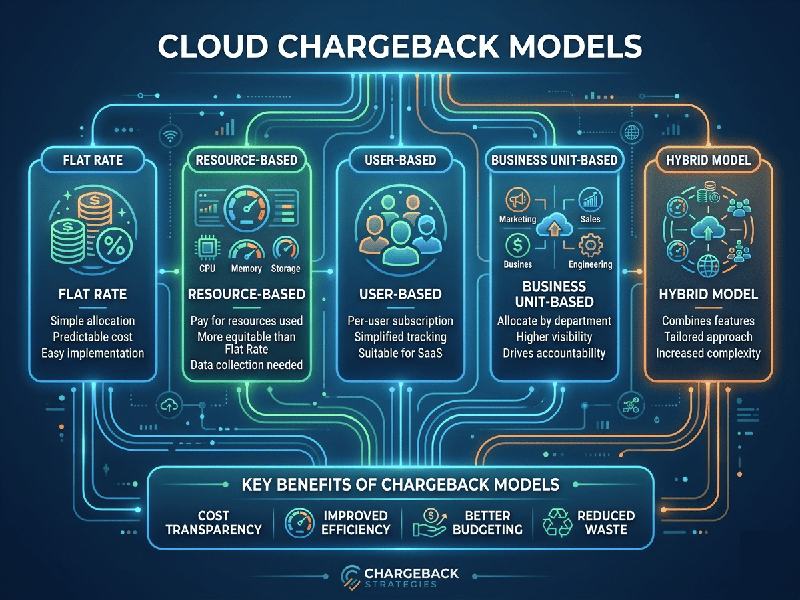
Cloud Chargeback Models
Cloud chargeback is a financial strategy where the costs of
cloud services are billed back to the specific departments, business units, or
projects that actually used them. It’s the "you use it, you pay for
it" approach to IT.
1. The Allocation-Based Model
In this model, costs are distributed based on pre-planned
budgets or estimated capacity rather than real-time consumption.
- How it works: If the Marketing department is
allocated 20% of the server's total capacity for the year, they pay 20% of
the bill, regardless of whether they actually hit those numbers.
- Best for: Organizations with very stable,
predictable workloads and those just starting their cloud journey.
- Pros: High budget predictability for
departments.
- Cons: Does not encourage efficient
use of resources (waste).
2. The Usage-Based Model (Pure Chargeback)
This is the most "authentic" cloud model, aligning
directly with the pay-as-you-go nature of the cloud.
- How it works: Costs are calculated based on actual
telemetry data (CPU hours, GB of storage, data egress). If a developer
spins up a massive GPU instance for three hours, their specific project
gets the bill for those three hours.
- Best for: Mature DevOps environments and
companies looking to eliminate "shadow IT."
- Pros: Drives accountability;
departments actively look for ways to shut down unused resources to save
money.
- Cons: Can lead to "bill
shock" if a department has an unexpected spike in usage.
3. The Tiered or Fixed-Rate Model
This acts as a middle ground, similar to a consumer cell
phone plan.
- How it works: IT sets "tiers" of
service. A "Small Lab Environment" might cost a flat $500/month,
while a "Production Cluster" costs 5,000/month.
- Best for: Organizations that want to
simplify internal accounting and avoid the complexity of tracking every
single kilobyte.
- Pros: Simple to understand and
invoice.
- Cons: IT often ends up
"under-charging" or "over-charging," leading to
internal friction.