Business Process Mapping Techniques
Deep Dive into Key Techniques
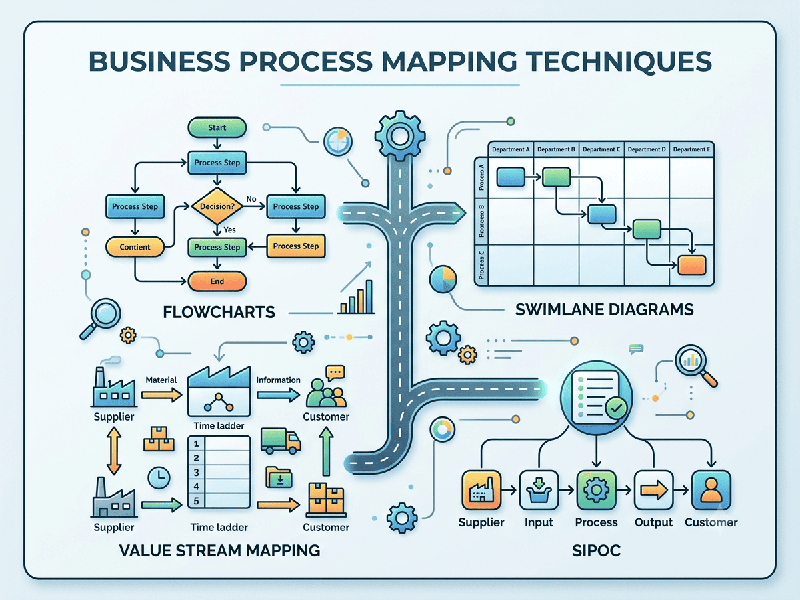
1. Flowchart (Process Map)
The most common technique. It uses standard symbols
(ovals for start/end, rectangles for activities, diamonds for decisions) to
show the flow of a single, linear process. It is excellent for training and
operational transparency.
2. Swimlane Diagram (Cross-Functional Map)
This organizes the flowchart into "lanes"
assigned to specific departments, roles, or software systems. It is the most
effective way to identify bottlenecks caused by hand-offs between different
teams.
3. Value Stream Mapping (VSM)
Originating from Lean manufacturing, this technique
maps the flow of materials and information required to bring a product or
service to a customer. It is uniquely powerful because it includes time
measurements to differentiate between "Value-Added" time and
"Waste" time.
4. BPMN
BPMN is a global standard for business process
modeling. It uses a sophisticated set of symbols to denote events, activities,
gateways, and artifacts. It is preferred for organizations planning to
implement automated workflows in Business Process Management (BPM) software.
5. SIPOC Diagram
Used during the Define phase of Six Sigma
projects, SIPOC stands for Suppliers, Inputs, Process, Outputs,
and Customers. It does not show the steps themselves but provides the
vital context needed before you begin mapping the granular details.
How to Choose the Right Technique
- For quick communication: Use Flowcharts.
- For accountability and hand-off
issues: Use Swimlane
Diagrams.
- For process improvement and cost
reduction: Use Value
Stream Mapping.
- For software/system
implementation:
Use BPMN or Data Flow Diagrams.
- For high-level project framing: Use SIPOC.