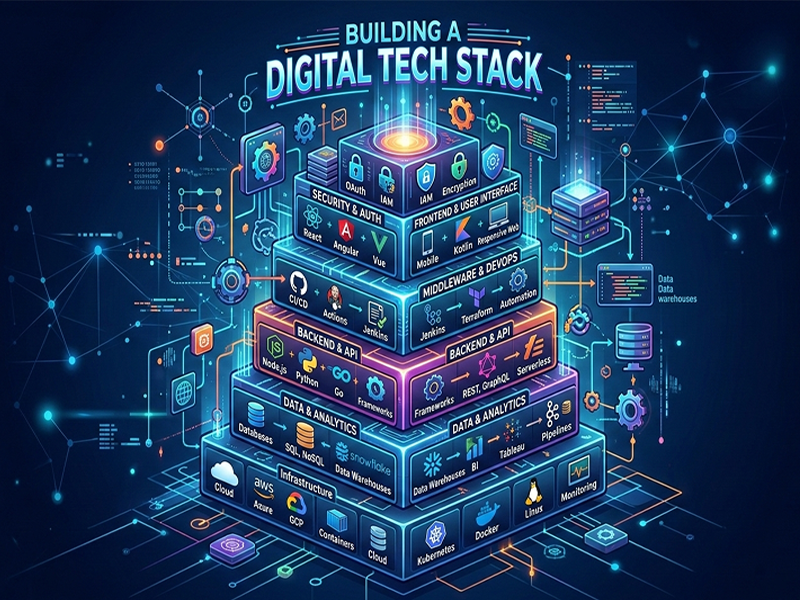
Building a Digital Tech Stack
Building a
digital tech stack is essentially like designing the nervous system of your
business. It’s not just about picking the "coolest" apps; it’s about
ensuring that every piece of software talks to the others to eliminate
friction.
Since you're
starting from the ground up, here is a breakdown of how to architect a modern,
scalable stack.
1. The
Core Layers
A functional
stack is usually divided into four primary layers. Each layer serves a specific
purpose in the journey from "stranger" to "loyal customer."
A. The
Front-End (Customer Experience)
This is what
the world sees. It includes your website, mobile app, and UI components.
- CMS (Content Management System): Webflow, Framer, or WordPress.
- E-commerce: Shopify or BigCommerce.
- Frameworks: React, Vue.js, or Next.js for
custom builds.
B. The
Operations & Data Layer (The Brain)
This is
where you manage relationships and keep the "truth" of your data.
- CRM (Customer Relationship
Management):
Salesforce (enterprise) or HubSpot (all-in-one).
- ERP (Enterprise Resource
Planning):
NetSuite or Odoo for inventory and finance.
C. The
Marketing & Growth Layer
Tools to
find, engage, and retain users.
- Email/Automation: Klaviyo, Mailchimp, or Braze.
- Analytics: Google Analytics 4 (GA4),
Mixpanel, or PostHog.
D. The
Infrastructure Layer
Where the
code and data live.
- Cloud Hosting: AWS, Google Cloud, or Azure.
- Databases: MongoDB, PostgreSQL, or
Snowflake for data warehousing.
2. The
"Glue" (Integrations)
The biggest
mistake companies make is building "silos"—tools that don't share
data. To build a cohesive stack, you need:
- IPaaS (Integration Platform as a
Service): Tools
like Zapier or Make to automate workflows between apps.
- APIs: Ensure any software you buy has
an open API so it can grow with you.
3. The
"MVP" Tech Stack Example
If you are a
mid-sized startup looking for the best "bang for your buck" today, it
might look like this:
- Website: Webflow
- CRM/Marketing: HubSpot
- Internal Comms: Slack + Notion
- Payments: Stripe
- Automation: Zapier
- Analytics: Fathom (privacy-focused)