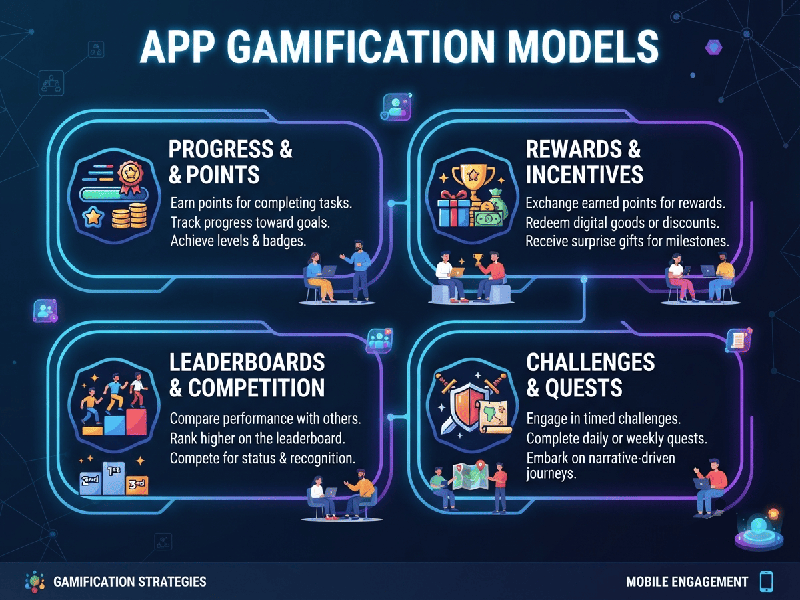
App Gamification Models
App
Gamification is the strategic integration of game-design elements and
mechanics into non-game applications (like productivity, e-commerce, or finance
apps) to increase user engagement, retention, and loyalty.
When applied correctly, gamification taps into human
psychology—specifically the desire for achievement, status, and feedback—to
turn mundane tasks into rewarding experiences.
Core Gamification Models & Mechanics
These models provide the "how-to" for
building rewarding user journeys:
- The Octalysis Framework: Created by Yu-kai Chou, this is
the most comprehensive framework. It identifies 8 "Core Drives"
of human motivation (e.g., Accomplishment, Ownership, Social Influence,
Scarcity). Great apps typically balance "Left-Brain" drives
(extrinsic rewards like points) with "Right-Brain" drives
(intrinsic rewards like creativity and social connection).
- The Hook Model: Developed by Nir Eyal, this
cycle focuses on building habits.
o Trigger: A reminder (notification).
o Action: The simplest behavior to get a
reward.
o Variable Reward: A reward that changes (e.g., a
"mystery" daily bonus or personalized insight).
o Investment: The user puts something in (e.g.,
filling out a profile, saving data), which makes them more likely to return.
- The Progression Model (S-L-P):
o Status: User levels or ranks (e.g., Bronze
to Platinum status).
o Leaderboards: Friendly competition among peers.
o Points/Badges: Clear visual indicators of progress.
Strategic Benefits for Enterprise/B2B Apps
In an enterprise context, gamification is less about
"playing a game" and more about guiding behavior:
- Improved Adoption: Users are more likely to learn
complex software (like an ERP or CRM) if the process is broken down into
small, rewarded tasks.
- Data Integrity: Gamify the "data
entry" process by rewarding employees for completing profiles or
updating records promptly.
- Reduced Training Costs: Interactive tutorials that act
like games reduce the need for extensive manual documentation or live
training sessions.
Implementation Best Practices
1.
Define the Goal First: Don't gamify for the sake of it. Decide what behavior you
want to drive (e.g., "Increase daily usage" or "Improve data
input accuracy").
2.
Focus on Intrinsic Motivation: Extrinsic rewards (points/badges) eventually lose their
appeal. Ensure the core experience of your app is valuable enough that
the gamification is just an added layer of delight.
3.
Ensure Cultural Relevance: For your users in the Indian market, consider localizing the
experience. Use culturally resonant milestones, and if you are rewarding users
with cash-back or savings, always ensure the financial visuals use the ₹
(Rupee) symbol.
4.
Avoid "Gamification Fatigue": Too many badges and notifications can become
annoying. Keep the mechanics subtle and relevant to the user’s current task.