App Feature Prioritization
Feature prioritization is the process of deciding what to
build next based on the value a feature provides versus the effort required to
create it. Since resources are always limited, this ensures the team stays
focused on what actually drives growth or user satisfaction.
1. The RICE Scoring Model
This is a data-driven approach that helps remove bias by
assigning a numerical score to each feature.
- Reach: How many users will this affect
in a given timeframe?
- Impact: How much will this contribute
to the goal? (Massive = 3, High = 2, Medium = 1).
- Confidence: How sure are you about your
estimates? (100% = High, 80% = Medium, 50% = Low).
- Effort: How much time will it take from
product, design, and engineering? (Measured in "person-months").
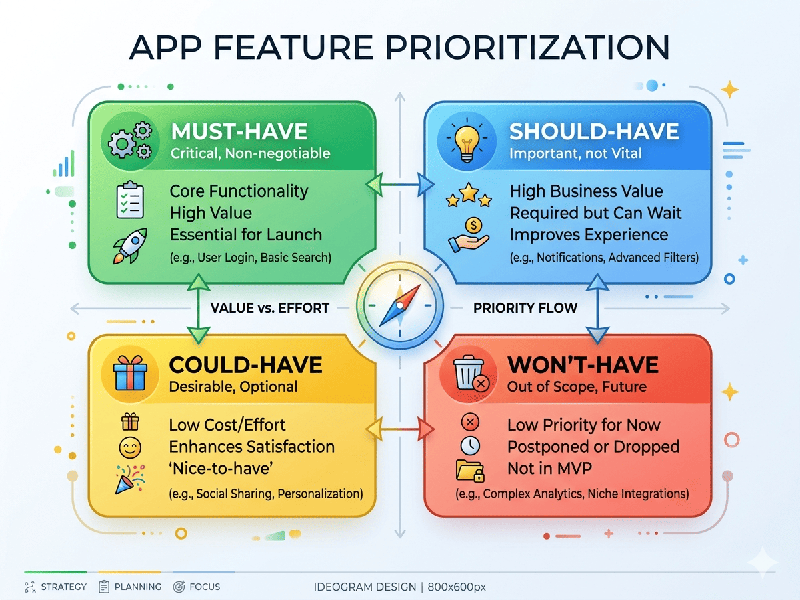
2. The MoSCoW Method
Best for stakeholders to understand what is non-negotiable
for a launch (MVP).
- Must-Have: Vital features; without these,
the product is non-functional.
- Should-Have: Important but not vital; can be
painful to leave out but the product still works.
- Could-Have: Desirable "small
wins" that improve experience but aren't necessary.
- Won't-Have: Agreed upon as a non-priority
for this specific release cycle.
3. Value vs. Effort Matrix
A visual 2x2 grid that helps teams quickly categorize tasks.
- Quick Wins (High Value, Low
Effort): Do
these first.
- Big Bets (High Value, High
Effort):
Strategic projects that need careful planning.
- Fill-ins (Low Value, Low
Effort): Tasks
to do when the team has a gap in their schedule.
- Thankless Tasks (Low Value, High
Effort): Avoid
these entirely.
4. The Kano Model
This framework focuses on customer satisfaction and
how users perceive the "delight" of a feature.
- Basic Features: Expected by the user (e.g., a
login button). If they aren't there, users are dissatisfied.
- Performance Features: The more you provide, the
happier the user (e.g., faster loading speeds).
- Excitement Features: Unexpected
"delighters" that set your app apart from competitors.
5. Opportunity Scoring
Derived from Outcome-Driven Innovation, this asks users to
rate features based on two questions:
1.
How
important is this outcome to you?
2. How satisfied are you with current solutions?