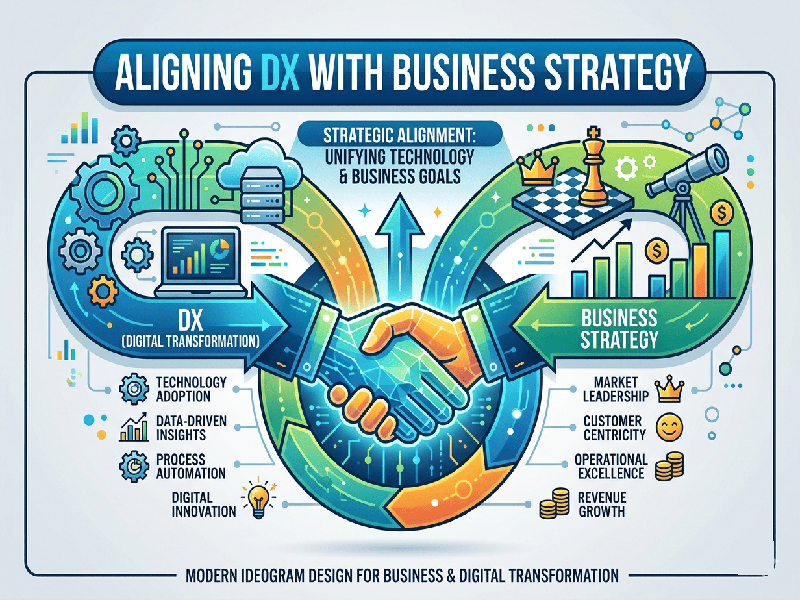
Aligning DX with Business Strategy
Aligning
Digital Transformation (DX) with business strategy is the difference between
simply buying new software and actually evolving a company. Without this
alignment, DX often becomes a series of expensive, disconnected "digital
islands."
1. Define
the Business North Star
Before
touching technology, identify the primary business driver. Digital tools should
only be implemented if they directly accelerate one of these:
- Operational Efficiency: Reducing costs or manual labor
through automation.
- Customer Experience: Improving retention,
personalization, or ease of access.
- Revenue Growth: Entering new markets or
creating digital-first products.
- Agility & Resilience: Increasing the ability to pivot
during market shifts.
2.
Conduct a Digital Maturity Assessment
Evaluate
where the organization currently stands to bridge the gap between "Current
State" and "Strategy State."
- Legacy Infrastructure: Can current systems handle
modern API integrations?
- Data Silos: Is critical business data
trapped in department-specific software?
- Culture: Is the workforce ready to adopt
new workflows, or is there significant resistance?
3.
Prioritize via the Value-Complexity Matrix
Not every
digital project is worth doing immediately. Map your initiatives to focus on
high-impact areas:
- Quick Wins: Low complexity, high business
value (e.g., automating a common customer query).
- Strategic Bets: High complexity, high value
(e.g., moving to a unified Cloud architecture).
- Fill-ins: Low complexity, low value
(e.g., minor UI tweaks).
- Money Pits: High complexity, low value (Avoid
these).
4.
Implement "Continuous Feedback" Loops
DX is not a
one-time project; it is a permanent shift.
- Define KPIs: Use metrics like Time to
Market, Customer Acquisition Cost (CAC), or Internal
Adoption Rates.
- Iterative Rollouts: Use agile methodologies to
deploy in phases, allowing the business strategy to adjust based on
real-world digital performance.
- Executive Ownership: Alignment fails if DX is
treated as an "IT problem." It must be led by the CEO or
business heads to ensure it stays focused on the bottom line.