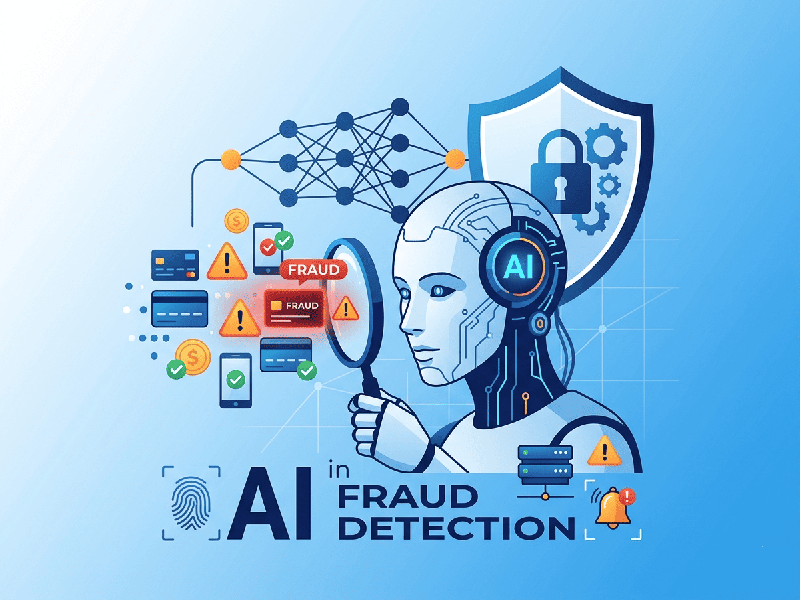
AI in Fraud Detection
The battle against fraud has entered an "AI vs. AI"
era. As fraudsters use Generative AI and Agentic AI to automate
hyper-realistic phishing and synthetic identity creation, organizations have
shifted from static, rule-based defenses to dynamic, real-time intelligence.
1. The Shift: Rules vs. AI-Driven Detection
Traditional systems rely on "if-then" logic (e.g., if
a transaction is > $10,000, then flag it). Modern AI looks for the
"why" and "how" behind the data.
2. Core AI Technologies in Fraud Prevention
A. Behavioral Biometrics
Instead of just checking what you know (password) or what
you have (phone), AI analyzes how you interact with your device.
- Signals: Typing cadence, swipe pressure,
mouse jitter, and even "hesitation patterns" before a large
transfer.
- Benefit: Detects
"Human-in-the-loop" fraud where a legitimate user is being
coached by a scammer over the phone.
B. Graph AI & Link Analysis
Fraudsters rarely act alone; they operate in
"rings." Graph AI maps the relationships between seemingly unrelated
accounts, IPs, and devices.
- Function: Identifies "Mule
Networks" by spotting clusters of accounts that share a single hidden
attribute, like a recycled device ID or a common high-velocity
destination.
C. Generative AI for Investigation
While GenAI is a tool for attackers, defenders use it to
summarize massive fraud cases.
- Automated Triage: AI assistants can instantly
scan thousands of pages of logs to highlight the exact moment a breach
occurred, reducing investigation time from days to minutes.
3. Emerging Threats in 2026
- Synthetic Identity Fraud: Fraudsters use GenAI to blend
real stolen data (like a SSN or PAN) with fake AI-generated faces and
voices to create "Frankenstein" identities that look perfectly
legitimate to automated KYC systems.
- Deepfake Scams: Real-time voice and video
cloning are now used in "Business Email Compromise" (BEC)
attacks, where an employee receives a video call from a "CEO"
(actually a deepfake) authorizing a fraudulent wire transfer.
- Agentic AI Attacks: Malicious autonomous agents can
now "probe" a bank's defense 24/7, testing millions of slight
variations in transaction behavior until they find a gap in the logic.
4. Implementation Strategy: The Layered Approach
A robust 2026 fraud strategy requires a
"Zero-Trust" mindset:
1.
Continuous Authentication: Don't just verify at login. Use AI to monitor the entire
session for sudden changes in behavior.
2.
Cross-Channel Visibility: Ensure your fraud engine sees data from your website, mobile
app, and physical branches simultaneously to spot coordinated attacks.
3.
Explainability (XAI): Ensure your AI doesn't just say "Deny," but provides a reason
(e.g., "Sudden change in typing speed + new IP range"). This
is critical for regulatory compliance and customer support.
4.
Consortium Data: Share anonymized threat data with other institutions. Fraudsters
collaborate; defenders must do the same.