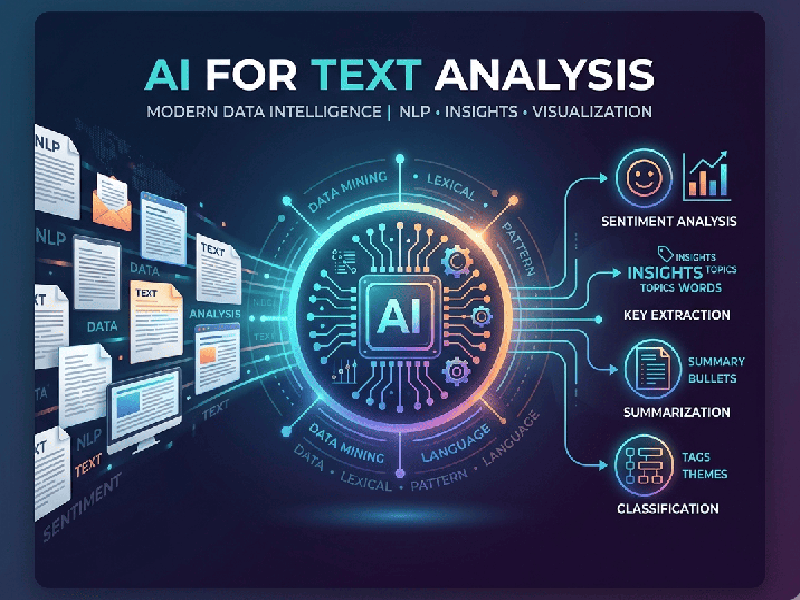
AI for Text Analysis
AI for text analysis has evolved from simple keyword counting
to sophisticated systems that understand context, emotion, and even the
"unspoken" gaps in a document. As of 2026, the landscape is defined
by Large Language Models (LLMs) and specialized platforms that automate deep
research.
1. Core AI Text Analysis Techniques
Modern AI uses Natural Language Processing (NLP) to
break down and "read" text much like a human would, but at a massive
scale.
- Sentiment & Emotion
Analysis:
Beyond just "positive" or "negative," AI now
identifies specific emotions like frustration, urgency, or sarcasm.
- Named Entity Recognition (NER): Automatically identifying and
categorizing people, organizations, locations, and dates within a text.
- Topic Modeling & Clustering: Grouping thousands of documents
into themes without needing manual labels.
- Semantic Search: Understanding the intent
behind a query rather than just matching keywords (e.g., searching for
"financial health" and getting results for "cash
flow").
- Content Gap Analysis: Advanced tools can now analyze
what is missing from a text based on industry standards or
competitor data.
2. Leading AI Tools for 2026
Depending on your goals—whether it's academic research,
business intelligence, or content creation—the "best" tool varies.
General & Creative Analysis
- Gemini & ChatGPT: Excellent for summarizing long
PDFs, comparing multiple documents, and "chatting" with your
data to find specific insights.
- Claude: Known for its high token
window, making it ideal for analyzing entire books or massive technical
manuals in one go.
Specialized Research & Data Tools
- Elicit / SciSpace: Specifically designed for
academic research; they extract data from millions of scholarly papers and
provide cited summaries.
- InfraNodus: Visualizes text as a knowledge
graph, showing how different concepts are connected and where the
"thematic gaps" exist.
- Chattermill: A favorite for businesses to
analyze customer feedback across social media, reviews, and support
tickets in real-time.