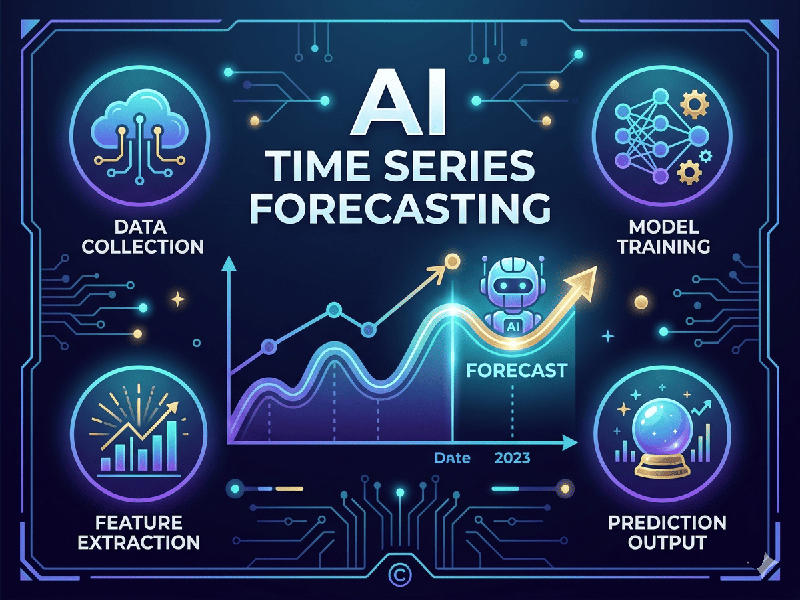
AI Time Series Forecasting
AI Time Series Forecasting involves using historical,
time-stamped data to predict future values. While traditional methods (like
ARIMA) dominated for decades, modern AI has introduced powerful deep learning
architectures and "foundation models" that can handle complex,
non-linear patterns much more effectively.
1. Key Components of Time Series
Before applying AI, it is crucial to understand what makes
your data "tick":
- Trend: The long-term direction of the
data (upward, downward, or flat).
- Seasonality: Repeating patterns at fixed
intervals (e.g., daily spikes in electricity usage or yearly holiday
shopping).
- Cycles: Fluctuations that are not at
fixed intervals (e.g., economic recessions).
- Irregularity/Noise: Random variations or
"black swan" events that cannot be predicted.
2. Machine Learning vs. Deep Learning
- Machine Learning (e.g.,
XGBoost): Often
faster and more interpretable. It treats forecasting as a regression
problem. It excels when you have many external variables (covariates) but
requires manual creation of "lags" (previous time steps).
- Deep Learning (e.g.,
Transformers/LSTMs): These models automatically learn "feature
representations" from the raw sequence. They are superior for massive
datasets with high complexity but require more computational power.
3. How to Evaluate Accuracy
You can't just use standard accuracy percentages. You need
metrics that measure the "distance" between the forecast and reality:
- MAE (Mean Absolute Error): The average of the absolute
differences between predicted and actual values. Easy to interpret (e.g.,
"we are off by $5 on average").
- RMSE (Root Mean Squared Error): Similar to MAE but penalizes
large errors more heavily. Use this if a "big miss" is much
worse than several "small misses."
- MAPE (Mean Absolute Percentage
Error): Shows
the error as a percentage. Great for comparing performance across
different products or scales.
- CRPS (Continuous Ranked
Probability Score): Used for Probabilistic Forecasting (when the model gives a
range/confidence interval instead of just one number).
4. Modern Workflow
1.
Stationarity Check: Determining if the data's mean/variance is constant. If not, you may
need to "difference" the data.
2.
Windowing:
Converting the time series into "windows" of input-output pairs
(e.g., use the last 30 days to predict the next 7).
3.
Backtesting:
Instead of a simple train-test split, you use a Rolling Forecast Origin
to simulate how the model would have performed at different points in the past.