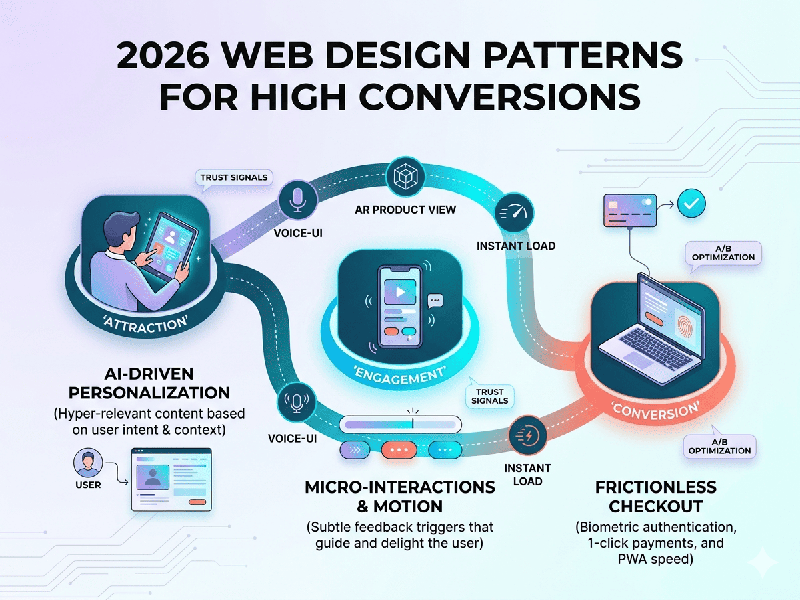
2026 Web Design Patterns for High Conversions
Web design has moved beyond static layouts. High-converting
sites are now living systems that use AI to adapt in real-time to user
behavior. To maximize conversions this year, you should implement these five
core patterns.
1. AI-Driven Adaptive Layouts
Standard A/B testing is being replaced by real-time
"Agentic" UI. The website doesn't just show one version to everyone;
it morphs based on the visitor's intent.
- Predictive CTAs: Buttons that change their label
or color based on the user's past interaction history or traffic source
(e.g., a "Quick Buy" button for returning users vs. "Learn
More" for new visitors).
- Dynamic Social Proof: Showing testimonials
specifically from users in the same industry or geographic location as the
visitor.
- Contextual Navigation: Menus that rearrange themselves
to highlight the features the user has shown the most interest in during
their current session.
2. The "Thumb-Zone" First Layout
With over 82% of landing page traffic now coming from
mobile devices, "Mobile-Responsive" isn't enough. You must design for
the "Thumb-Zone."
- Bottom-Anchored Actions: Place primary conversion
buttons (Add to Cart, Sign Up) at the bottom of the screen where thumbs
naturally rest.
- Vertical Progressive Disclosure: Instead of long scrolling
pages, use vertical "stories" or "cards" that users
tap through, similar to social media interfaces. This maintains engagement
without overwhelming the user.
3. Micro-Interactions as Psychological Cues
In 2026, motion isn't just "flavor"—it's a guide.
Purposeful micro-animations reduce the "cognitive load" of making a
decision.
- Success Reinforcement: A subtle green pulse or
haptic-style animation when a user correctly fills out a form field.
- Progressive Reveals: Content that fades in slightly
as the user lingers on a section, signaling that there is more value to be
found by staying.
- Frictionless Forms: Using "Smart
Defaults" and "Auto-Advance" patterns where the next
question appears automatically once the previous one is answered.
4. Trust Through "Invisible" Security
Users are more privacy-conscious than ever. High-converting
patterns now weave trust directly into the UI.
- Wallet-Based Authentication: Offering "Login with
Wallet" (Web3) or biometric passkeys (FaceID/TouchID) instead of
traditional email/password forms.
- Real-Time Data Transparency: A small, non-intrusive badge
that updates to show the site is currently scanning for threats or that
the user’s data is being processed locally via Edge computing.
5. Narrative Navigation & Kinetic Type
Large walls of text are conversion killers. 2026 design uses Kinetic
Typography—text that moves or changes scale—to tell a story.
- Oversized Scrollytelling: Using massive, bold headlines
that trigger background changes or 3D model rotations as the user scrolls.
This keeps the user "locked in" to the narrative flow.
- Direct-Action Messaging: Using first-person copy like
"Get My Free Audit" rather than "Get Your
Free Audit." This subtle shift in design psychology significantly
increases "ownership" and click-through rates.