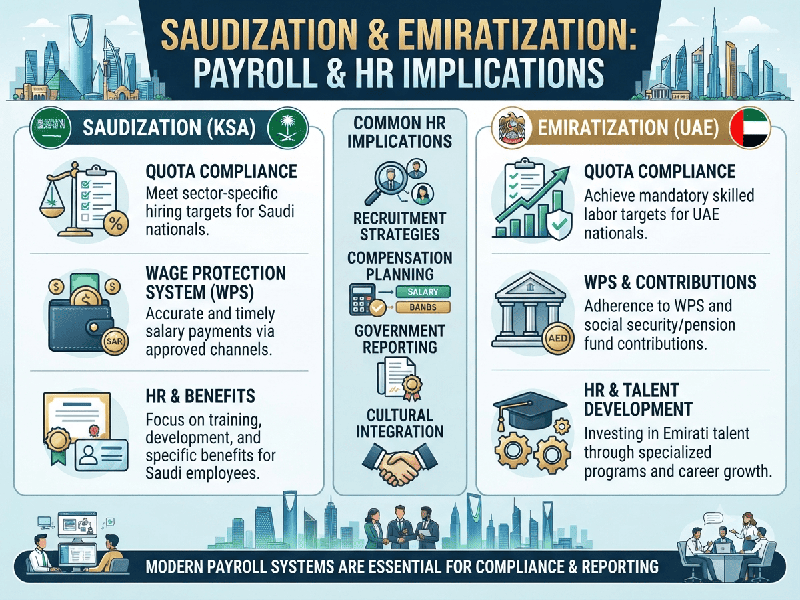
Saudization and Emiratization: Payroll and HR Implications
Saudization (Nitaqat) and Emiratization (Nafis
/ MoHRE) are mandatory nationalization frameworks in Saudi Arabia and the
UAE that directly link workforce demographics to payroll processing, statutory
social security deductions, minimum wage floors, and visa/work permit
privileges.
1. Payroll Implications
Salary Floors & Weighted Headcount Calculation
Saudi Arabia (Fractional Counting & Wage Floors): Payroll teams cannot simply count
heads. Under Nitaqat, a Saudi employee's registered GOSI wage determines
whether they count as 1.0, 0.5, or 0 toward the quota. Furthermore,
profession-specific localization rules impose higher salary floors—for example,
Saudi engineers require at least SAR 8,000/month (plus Saudi Council of
Engineers accreditation), marketing roles require SAR 5,500/month, and
degree-holding accountants require SAR 6,000/month to count toward
sector quotas.
UAE (Hard Minimum Wage): From July 1, 2026, any Emirati paid
below AED 6,000/month is automatically excluded from MoHRE's
Emiratization denominator, and the company faces work permit suspensions until
payroll records and contracts are amended.
Dual-Track Social Security & Pension Deductions
Payroll software must separate nationals from
expatriates because statutory deductions differ drastically:
Saudi Arabia (GOSI): Calculated on Basic Salary + Housing Allowance
(capped at SAR 45,000/month). Payroll deducts 9.75% from the Saudi
employee (9% pension + 0.75% Saned unemployment) and accrues 11.75% as
an employer cost (9% pension + 0.75% Saned + 2% occupational hazard), payable
by the 15th of the following month.
UAE (GPSSA):
Two-Tier Pension Law: Payroll must track when an
Emirati first entered the pension system. Employees insured for the first time
after October 31, 2023 fall under Federal Decree-Law No. 57 of 2023 (11%
employee deduction; 15% employer contribution on basic + housing + social
allowances, up to a AED 70,000 private-sector cap). Employees with prior
insurance history remain under the legacy 1999 Law (5% employee
deduction).
End of Nafis Pension Subsidy: Under the revised September 2026
Nafis framework, private employers are now required to pay their full statutory
employer pension share for new Nafis beneficiaries rather than relying on
multi-year government coverage.
Part-Time Coverage: Emiratis working part-time (8–32 hours/week) must
also be registered on the GPSSA Ma'ashi portal with pro-rata
contribution tracking.
End-of-Service Gratuity (EOSB) vs. Pension
Expatriates in both countries accrue statutory End-of-Service Gratuity
(or UAE Savings Scheme contributions) upon termination.
Nationals registered under GOSI (KSA) or GPSSA (UAE) are exempt
from statutory EOSB accruals, as state pension contributions replace
end-of-service gratuity—preventing double liability on company balance sheets.
Government Subsidies & Wage Protection System
(WPS) Alignment
Nafis (UAE) & Hadaf (KSA): Government salary top-ups (such as
Nafis monthly bachelor's/diploma allowances and child allowances) are paid
directly to the citizen's bank account, not through the employer's
payroll. However, the employer's WPS Salary Information File (SIF) must still
reflect the full contractual salary and accurate pension deductions so MoHRE
and GPSSA systems reconcile without triggering compliance flags.
2. HR & Workforce Planning Implications
Strict Job Title & Occupational Classification
Governance
Saudi Arabia (Profession-Specific Quotas): HR can no longer offset low
Saudization in core functions by hiring nationals solely as drivers or
receptionists. In 2026, Saudi Arabia enforces strict profession
quotas—including 100% across 69 administrative support roles, 70%
in procurement, 60% in marketing and sales, 50% in accounting
(rising to 60% in 2027), and 30% in engineering. Every job title on Qiwa
and Iqama must match actual duties.
UAE (Skilled Denominator Inflation): Emiratization targets apply strictly
to Skill Levels 1 to 5 (specifically 1–3 for skilled quotas: managers,
professionals, technicians, and clerks). Giving expatriate administrative or
junior staff inflated titles like "Manager" or "Specialist"
on their MoHRE work permits artificially inflates the company's skilled
headcount denominator, forcing the company to hire more Emiratis.
Mandatory Digital Contract & Portal
Synchronization
Saudi Arabia (Qiwa): Since April 15, 2026, a Saudi employee does
not count toward Nitaqat at all unless their employment contract is digitally
authenticated on Qiwa and matches GOSI wage records.
UAE (MoHRE & Ma'ashi): An Emirati hire only counts toward
the 30 June / 31 December MoHRE checkpoints if three records align
simultaneously: an active MoHRE work permit, an active GPSSA pension
registration on Ma'ashi, and regular monthly WPS salary transfers.
Attrition Management & Grace Periods
UAE 60-Day Replacement Window: If a UAE national resigns, MoHRE
grants a 2-month (60-day) grace period to hire and register a
replacement before the AED 10,000/month shortfall fine applies—provided HR
maintains documented proof of active recruitment.
Saudi Arabia Rolling 26-Week Average: Nitaqat evaluates compliance using a
rolling 26-week moving average (alongside instant checks for profession
quotas), meaning sudden resignations without immediate backfills will gradually
erode a company's Green status and freeze visa issuance.