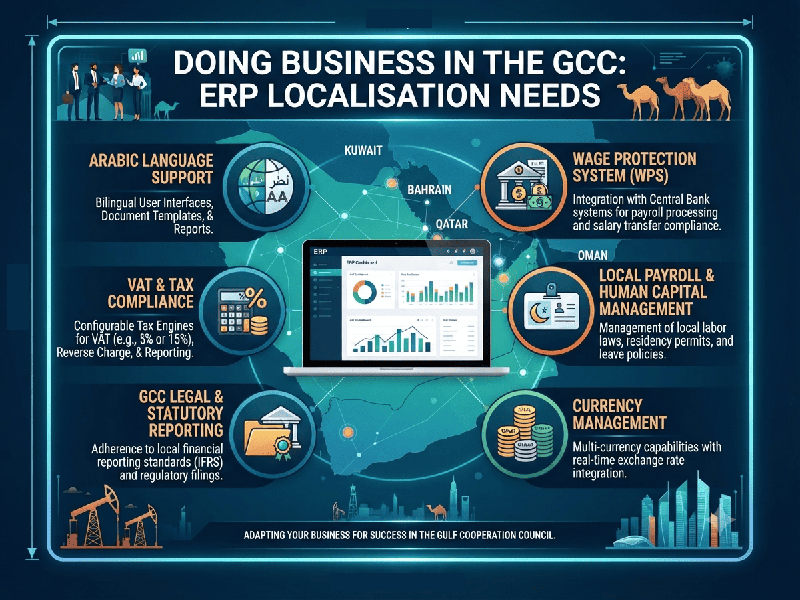
Doing Business in the GCC: ERP Localisation Needs
Doing business across the Gulf Cooperation Council
(GCC)—Bahrain, Kuwait, Oman, Qatar, Saudi Arabia, and the United Arab
Emirates—requires treating ERP localization as a core architectural foundation
rather than a post-launch translation task. Although the GCC shares cultural
and commercial ties, it is not a single tax or regulatory jurisdiction:
each country enforces its own tax rates, e-invoicing rules, labor filings, and
data privacy laws.
1. Multi-Entity & Country-Specific Tax
Architecture
Copying one country's tax setup across GCC entities
often causes rejected filings, invalid tax credits, or audit exposure.
Separate Entity Configuration: Isolate legal entities, tax
registration numbers (such as UAE TRN), document numbering series, and
statutory return formats per jurisdiction rather than forcing multiple
countries onto one shared tax configuration.
Diverse VAT & Corporate Tax Regimes: VAT rates, registration thresholds,
exempt/zero-rated rules, and filing portals vary across member states (for
example, 15% standard VAT in Saudi Arabia, 5% in the UAE and Oman, and 10% in
Bahrain, while Qatar and Kuwait have distinct tax landscapes), alongside
evolving corporate tax frameworks.
Reverse Charge & Import VAT: Cross-border service imports, goods
imports, and specific domestic B2B categories frequently trigger reverse-charge
accounting—requiring your ERP to post both output tax and eligible input tax
cleanly—as well as reconciliation between customs import declarations and
ledger entries.
Audit-Ready Controls: Enforce strict sequential numbering
without gaps, lock tax calculation rules (such as line-level vs. invoice-level
rounding) in system logic rather than print templates, and maintain multi-year
retention archives.
2. E-Invoicing & Real-Time Reporting
E-invoicing in the GCC has moved well beyond
generating a standard PDF or spreadsheet.
Structured Payloads & Clearance/Reporting: In markets like Saudi Arabia (ZATCA
Fatoora Phase 2), systems must generate structured electronic formats (such as
XML or PDF/A-3 with embedded XML), cryptographic stamps/UUIDs/QR codes, and
integrate via APIs for real-time clearance (standard/B2B invoices) or reporting
within statutory windows (simplified/B2C invoices).
Regional Rollouts & Accredited Service Providers: Other GCC states are rolling out or
expanding e-invoicing mandates through national portals or accredited service
providers (ASPs). Your ERP needs validation rules, error/exception queues, and
audit trails for rejected or corrected invoices.
3. Bilingual Arabic/English UX, Calendars &
Currencies
True localization goes deeper than translating button
labels.
RTL Interface & Bilingual Documents: Support right-to-left (RTL)
navigation and layouts alongside English, bilingual master data and tax
invoices, proper Arabic letter shaping, and bidirectional (BiDi) handling for
mixed text, numbers, and codes.
Dual Calendars: Support both Gregorian and Hijri calendars
across contracts, official dates, reporting, and payroll/HR workflows where
local conventions or regulations expect them.
Multi-Currency & Exchange Rates: Handle local GCC currencies (SAR,
AED, BHD, OMR, QAR, KWD) alongside foreign billing currencies, ensuring
exchange rates and local-currency tax equivalents follow central bank or
statutory rules on the relevant date.
4. Payroll, Social Insurance & Data Residency
Operational localization also touches workforce
compliance and where data is hosted.
Payroll & Social Insurance: Where HR and payroll run in the ERP,
integrate with national Wage Protection System (WPS) salary file
standards and local social insurance/pension bodies (such as GOSI in Saudi
Arabia) to avoid monthly manual re-entry.
Data Residency & Privacy: Check where ERP and cloud databases
are hosted and how cross-border transfers are governed under local data
protection laws (such as Saudi Arabia's PDPL overseen by SDAIA), including
access controls, audit logs, and data-subject request workflows.