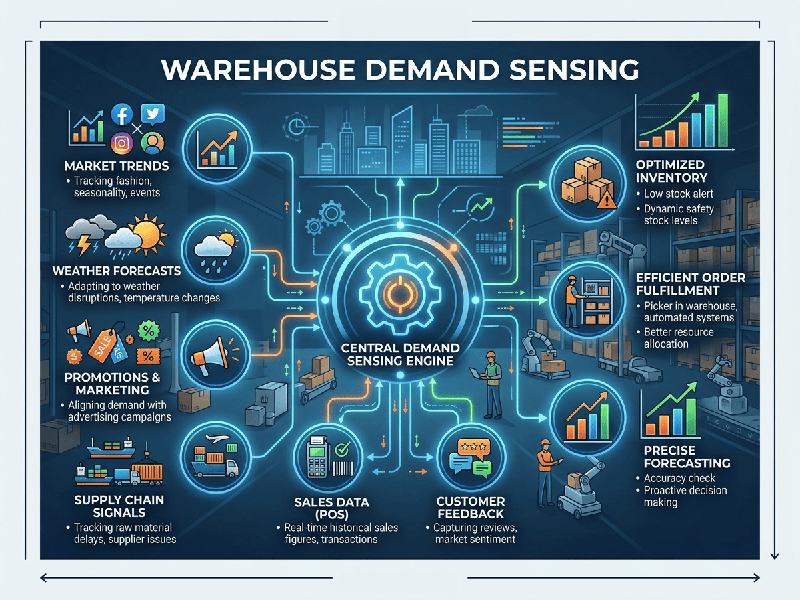
Warehouse Demand Sensing
Warehouse Demand Sensing is a modern, short-term forecasting
methodology that uses real-time data, Artificial Intelligence (AI), and machine
learning to detect and respond to sudden shifts in customer demand.
While traditional demand forecasting relies heavily on
historical sales data to plan months or years in advance, demand sensing acts
as a "real-time pulse," updating forecasts daily or even hourly to
handle volatility over a 0 to 13-week horizon.
How It Benefits Warehouse Operations
Integrating demand sensing into your warehouse
management strategy offers several tactical advantages:
- Minimized Stockouts and
Overstock: By
reacting to actual daily consumption trends rather than static historical
averages, you keep inventory levels lean and precise.
- Improved Agility: Warehouse managers can
reposition inventory to locations where it is needed most, based on
real-time geographical interest or local events.
- Reduced Operational Costs: You avoid the high costs of
emergency shipments, last-minute expedited labor, and unnecessary storage
for slow-moving items.
- Better Promo Management: AI can identify "halo
effects" (where one product's promotion boosts sales of another) and
"cannibalization" (where a promotion steals sales from a similar
item), allowing for smarter stock staging.
The Relationship Between Planning and Sensing
It is helpful to think of them as complementary, not
competing:
1.
Demand Planning (The Strategy): Focuses on the "Big Picture"—long-term budget,
production capacity, and strategic supply chain alignment (3–18 months).
2.
Demand Sensing (The Execution): Focuses on "The Now"—tactical, daily adjustments
to replenishment and distribution (0–13 weeks).
In essence, demand sensing is the layer of agility
that ensures your long-term plans remain accurate and actionable in an
unpredictable market.