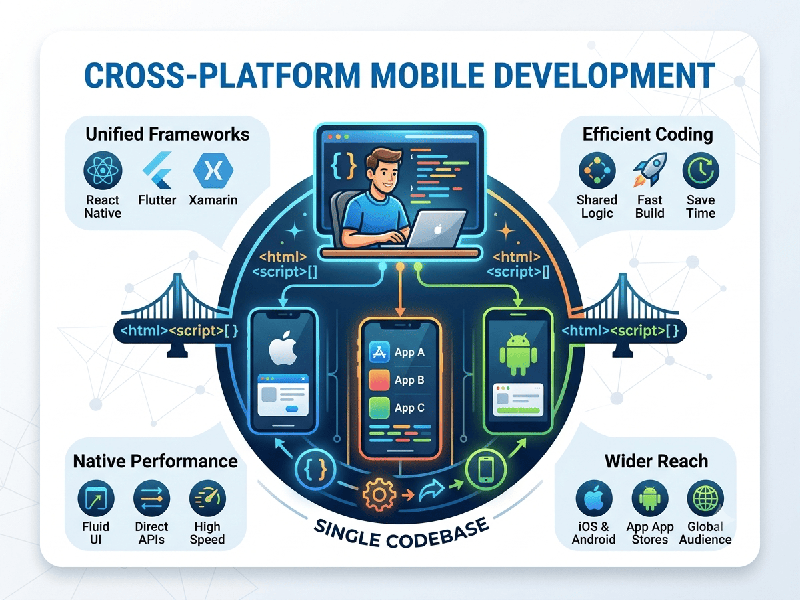
Cross-Platform Mobile Development
Cross-platform mobile development is the practice of creating mobile applications that are compatible with multiple operating systems (primarily iOS and Android) using a single codebase. Instead of writing separate apps in native languages—like Swift or Objective-C for iOS and Java or Kotlin for Android—developers use tools that allow them to "write once, run anywhere."
Key Advantages and Challenges
Advantages
- Reduced Development Cost: Maintaining a single codebase
significantly lowers the time and budget required for development and
maintenance.
- Faster Time-to-Market: Updates and new features can be
deployed simultaneously to both Apple App Store and Google Play Store.
- Unified Codebase: Easier to manage bug fixes,
feature parity, and team resources.
Challenges
- Performance Constraints: While modern frameworks have
closed the gap, highly complex apps (like those requiring heavy GPU usage
or deep hardware access) may still perform better when built natively.
- Platform-Specific Quirks: Even with cross-platform tools,
developers often have to write "bridge" code or
platform-specific modules to handle distinct UI behaviors or hardware
APIs.
- Dependency on Framework Updates: If the framework provider
(e.g., Google or Meta) updates the core engine, developers may need to
refactor parts of their app to maintain compatibility.
Should You Choose Cross-Platform?
You should consider a cross-platform approach if:
- You are a startup looking to
validate an MVP (Minimum Viable Product) quickly.
- The application is primarily
content-driven or data-heavy (e.g., e-commerce, social networking,
dashboards).
- Your team has specific expertise
in JavaScript (React Native) or C# (.NET MAUI).
You may want to stick to Native Development if:
- Your app requires highly complex
animations or cutting-edge, low-level hardware access (e.g., advanced AR,
complex signal processing).
- Top-tier performance is the
absolute most critical requirement for your business model.