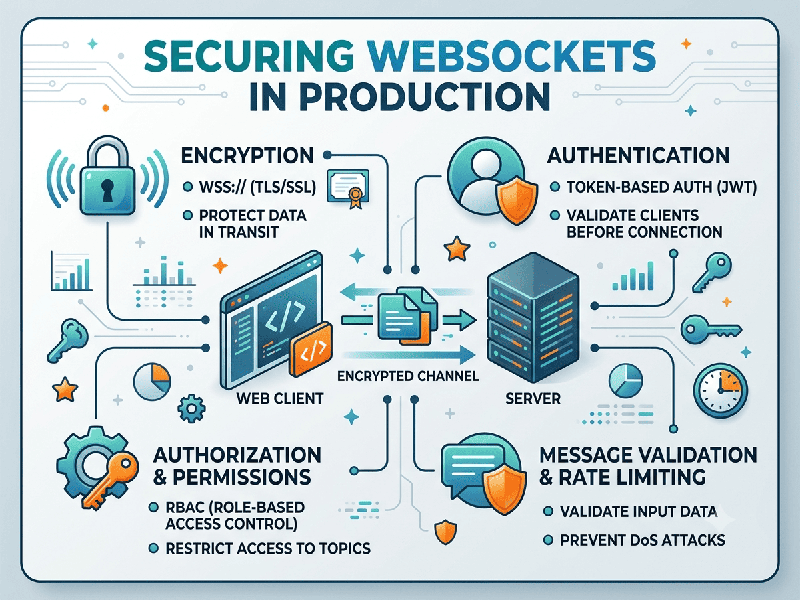
Securing WebSockets in Production
Securing WebSockets in production requires a
multi-layered approach because the protocol itself is a persistent, stateful
connection that operates differently from traditional request-response HTTP
cycles. Since WebSockets do not natively enforce authentication or encryption,
you must implement these controls at the transport, handshake, and application
layers.
1. Transport Layer Security (Encryption)
- Always use wss://: Never use ws:// in production.
wss:// (WebSocket Secure) tunnels the traffic through TLS, providing the
same encryption and integrity guarantees as HTTPS.
- TLS Termination: Typically, you terminate TLS at
your reverse proxy (e.g., Nginx, HAProxy, or a cloud Load Balancer). This
offloads the encryption burden from your application server, allowing it
to focus on handling application logic.
2. Handshake Authentication
Authentication should happen during the initial HTTP
upgrade request—before the connection is established.
- Cookie-based Authentication: If your web app uses cookies,
the browser will automatically include them in the handshake request. Your
server can validate these cookies just like any other HTTP request.
- Token-based Authentication
(JWT): Since
the browser WebSocket API doesn't allow adding custom headers to the
handshake, a common pattern is to pass an authentication token as a query
parameter (e.g., wss://api.example.com/socket?token=XYZ).
o Security Note: Ensure your infrastructure (load
balancers/logs) does not log full query strings, as this might expose tokens in
plain text.
- Ticket-based System: For higher security, have the
client request a short-lived, single-use "ticket" via a standard
POST request over HTTPS. The client then passes this ticket in the
WebSocket handshake. The server validates the ticket, checks its
expiration/usage status, and only then upgrades the connection.
3. Protecting Against Hijacking & Injection
- Validate the Origin Header: During the handshake, always
verify that the Origin header matches your allowed domains. This prevents Cross-Site
WebSocket Hijacking (CSWSH), where a malicious site attempts to open a
WebSocket connection to your server using the victim's session cookies.
- Strict Input Validation: Treat every message coming from
a client as untrusted input. Just because the connection is
"open" does not mean the data is safe. Validate the structure,
type, and length of incoming messages to prevent SQL injection, XSS, or
command injection.
- Limit Message/Payload Size: Configure your server to reject
messages exceeding a reasonable size (e.g., 64KB or 1MB) to prevent memory
exhaustion attacks.
4. Denial-of-Service (DoS) Mitigation
WebSockets are vulnerable to resource exhaustion
because a single client can hold a connection open indefinitely or flood the
server with high-frequency messages.
- Rate Limiting: Implement rate limiting on the number
of connections per IP address and the number of messages sent
per client per second.
- Connection Timeouts: Implement server-side timeouts
to close idle connections. Use "heartbeats" (Ping/Pong frames)
to keep legitimate connections alive while identifying and killing dead or
zombie connections.
- Resource Management: Ensure your architecture has
enough head-room to handle the concurrency load, as maintaining thousands
of open sockets consumes significant server memory.
5. Monitoring & Maintenance
- Logging: Log connection attempts,
authentication failures, and unusual spikes in traffic.
- Keep Dependencies Updated: WebSocket libraries are
frequently updated to patch security vulnerabilities. Ensure your
server-side implementation (e.g., Socket.io, ws for Node.js, etc.) is
patched.
- Avoid Tunneling: Do not allow clients to tunnel
raw TCP services (like database connections) through the WebSocket. Keep
the communication focused on high-level application data.