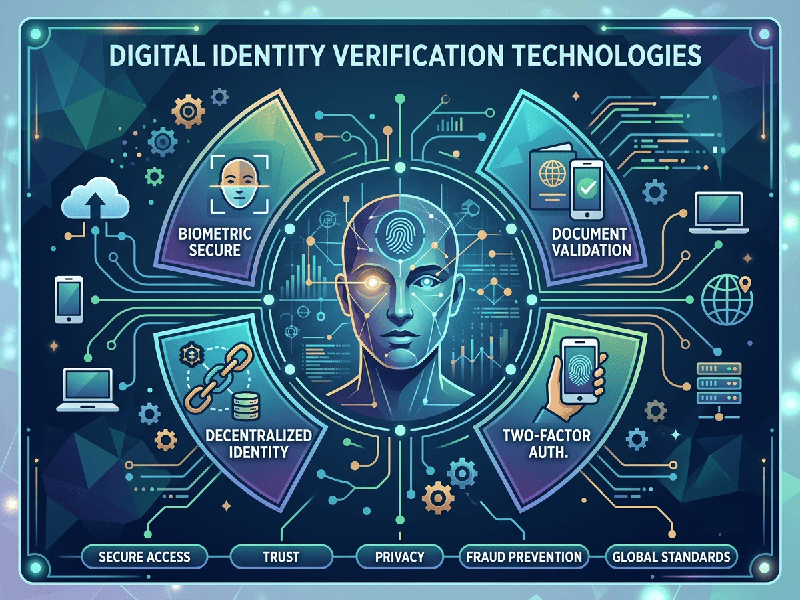
Digital Identity Verification Technologies
As of 2026, Digital Identity Verification (IDV)
has evolved from a simple "checkpoint" into a continuous, risk-based
process. For organizations like those in international trade or B2B services,
the focus has shifted toward preventing sophisticated AI-driven fraud (like
deepfakes) while maintaining a seamless user experience.
1. Core Verification Technologies
Modern systems utilize a "layered" approach,
combining these technologies to build a high-assurance identity profile:
- Biometric Verification: The industry standard for
confirming physical presence. It uses facial recognition, fingerprinting,
or voice analysis. In 2026, the focus is on on-device liveness
detection—using AI to ensure the user is a real person rather than a
high-resolution video or a deepfake mask.
- Document-Based Verification: Systems now use advanced Optical
Character Recognition (OCR) and NFC (Near Field Communication)
scanning. By reading the secure, encrypted chips inside modern passports
or national IDs via NFC, systems can verify authenticity far more reliably
than traditional visual document inspection.
- Data-Based Verification: Cross-referencing user-provided
info against authoritative third-party databases (e.g., government
records, credit bureaus). This provides a "sanity check" to
ensure the identity exists and is linked to the claimed attributes.
- Zero-Knowledge Proofs (ZKP): A cryptographic advancement
that allows a user to prove a claim (e.g., "I am over 18" or
"I am a verified exporter") without sharing the raw, sensitive
underlying data. This significantly reduces data breach liability.
2. Emerging Trends in 2026
- Deepfake Defense as a KPI: Organizations now treat
deepfake detection as a baseline security requirement, not an optional
feature. This includes using PAD-certified (Presentation Attack Detection)
biometrics.
- Digital Identity Wallets: Government-backed digital
wallets are scaling globally, allowing users to store verifiable
credentials (like licenses or professional certifications) and share them
selectively, reducing the need for repeated manual document uploads.
- Agentic AI Authentication: As autonomous AI agents begin
acting on behalf of users, "identity" is now being extended to
these agents. They must be registered, authenticated, and authorized just
like human users.
- Continuous Workforce Assurance: Verification is no longer just
for onboarding. Organizations are moving toward continuous verification,
which monitors device posture, network context, and intermittent biometric
checks to ensure that the person accessing a system is the same one who logged
in.
3. Strategic Checklist for B2B/Exporters
To maintain trust in cross-border professional
environments, consider these steps:
1.
Prioritize "Reusable" Identity: Favor systems that support
verifiable credentials, as this allows your partners to prove their identity
once and use it across different services without re-uploading sensitive
documents.
2.
Automate KYC/AML: Use automated IDV platforms to ensure compliance with global trade and
financial regulations without slowing down the onboarding of new suppliers or
partners.
3.
Implement Multi-Factor Authentication (MFA): Moving toward passwordless systems
(using passkeys) is now the recommendation to reduce the risk of account
takeovers.
4.
Validate the "Device," Not Just the "User": Ensure your system checks the
"health" of the device (e.g., is it jailbroken? is it a known bot
origin?) in addition to verifying the human user.