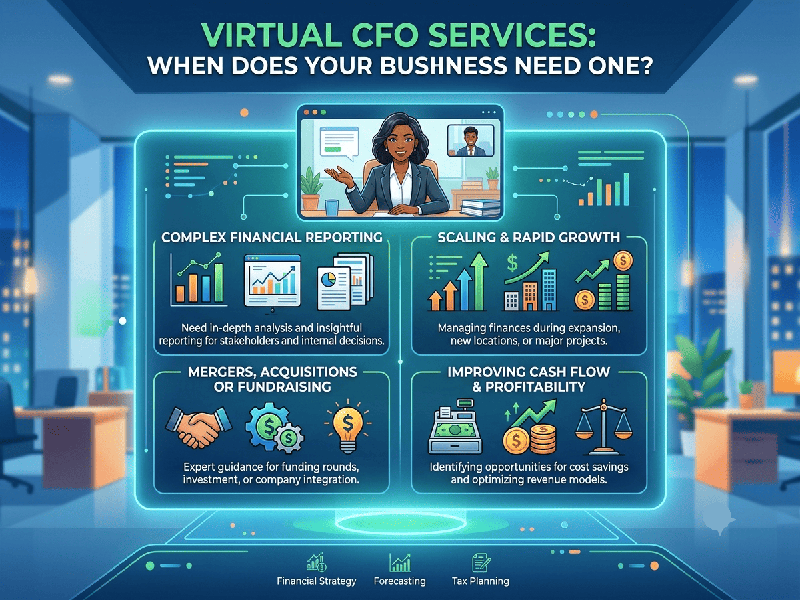
Virtual CFO Services: When Does Your Business Need One?
A business typically needs Virtual CFO (vCFO)
services when financial complexity outgrows basic bookkeeping and tax
compliance, yet hiring a full-time Chief Financial Officer ($180,000–$300,000+
or ₹35L–₹80L+ annually) is not financially justified.
Most growing companies hit this inflection point
between $1M and $20M in annual revenue (roughly ₹8 Cr to ₹150 Cr),
or whenever strategic financial decisions carry high capital risk.
7 Clear Signs Your Business Needs a Virtual CFO
Revenue Is Growing, But Cash Flow Feels Tight
You show strong paper profits on your Profit &
Loss statement, yet you struggle to make payroll or cover vendor bills due to
working capital bottlenecks, slow accounts receivable, or poorly timed
inventory purchases.
You Are Preparing to Raise Capital or Take Debt
Investors, venture capital firms, and banks require
institutional-grade 3-to-5-year financial models, unit economics (CAC, LTV,
burn rate, runway), valuation defense, and data-room readiness during due
diligence.
You Lack Forward-Looking Financial Visibility
Your current accountant tells you what happened
last month (historical compliance), but nobody is building rolling 13-week
cash flow forecasts, scenario models, or budget-vs-actual variance analyses to
guide what happens next.
Margins Are Shrinking Without a Clear Cause
Rising COGS, unmonitored SaaS/vendor creep, or
mispriced product lines are eroding net margins, and you need granular
SKU-level, project-level, or client-level profitability tracking.
Rapid Scaling or Multi-Entity Expansion
Expanding into new states or countries introduces
multi-jurisdiction tax nexus, transfer pricing, consolidated financial
reporting, and ERP implementation challenges that overwhelm standard
bookkeepers.
You Are Making Gut-Feel Strategic Decisions
Hiring senior staff, launching new product lines, or
entering major lease/capex commitments without stress-testing how those moves
impact cash runway and break-even timelines.
Board, Investor, or Audit Scrutiny Is Increasing
Stakeholders expect structured monthly Management
Information System (MIS) packs, KPI dashboards, and GAAP/Ind AS-compliant
reporting rather than raw accounting exports.