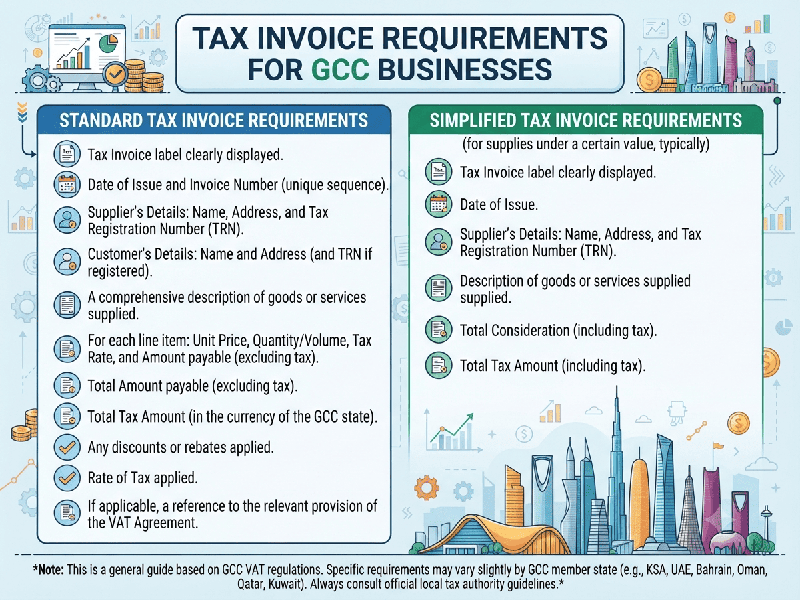
Tax Invoice Requirements for GCC Businesses
To be legally valid—and to allow business buyers to
reclaim input Value Added Tax (VAT)—tax invoices across the Gulf Cooperation
Council (GCC) must satisfy both baseline VAT content rules and country-specific
e-invoicing mandates. While the six member states share a unified GCC VAT
Framework Agreement, four countries (Saudi Arabia, the UAE, Oman, and
Bahrain) currently enforce VAT, whereas Kuwait and Qatar have not yet
implemented a general VAT regime.
1. Core Mandatory Fields (Standard B2B Tax Invoice)
Across VAT-implementing GCC jurisdictions (KSA, UAE,
Oman, and Bahrain), a standard tax invoice must display the following elements:
Document Title: The explicit heading "Tax Invoice" (in
Arabic and/or English, depending on local language mandates).
Supplier Identification: Legal name, registered business
address, and the supplier's VAT Registration Number / TRN / TIN
(typically 15 digits in KSA and the UAE).
Buyer Identification: Customer's legal name and address.
The buyer's VAT registration number is mandatory for B2B transactions in Saudi
Arabia and required in the UAE whenever the supply value exceeds AED 10,000
(or when the buyer is registered and accounting for tax).
Sequential Numbering & Dates: A unique, uninterrupted sequential
invoice number, the invoice issue date (plus exact timestamp in KSA),
and the date of supply if different from the issue date.
Line-Item Breakdown: Clear description of goods or services supplied,
quantity/unit of measure, unit price excluding VAT, any line-level discounts,
applicable VAT rate per item (15%, 10%, 5%, 0%, or Exempt), and line-level VAT
amount.
Invoice Totals & Currency: Total taxable amount (net of
discounts), total VAT payable, and gross total inclusive of VAT. If billed in a
foreign currency, the VAT amount must also be converted and displayed in the
local GCC currency (SAR, AED, OMR, or BHD) using the central bank /
approved exchange rate.
2. Special Invoicing Scenarios & Compliance
Controls
Simplified Tax Invoices (B2C / Low-Value Retail): Allowed for supplies to unregistered
end-consumers (B2C) or low-value transactions below statutory thresholds (e.g.,
under SAR 1,000 in Saudi Arabia or AED 10,000 in the UAE).
Simplified invoices omit buyer details, display VAT-inclusive line totals, and cannot
be used by B2B buyers to claim input VAT deductions.
Credit & Debit Notes (No Invoice Deletion): Once issued or cleared, tax invoices
cannot be deleted or overwritten. Price adjustments, returns, or errors must be
corrected by issuing a formal Tax Credit Note or Tax Debit Note
referencing the original invoice number, the reason for adjustment, and the
revised tax delta.
Zero-Rated, Exempt & Reverse Charge Supplies: Invoices for zero-rated exports or
domestic zero-rated goods must explicitly state 0% VAT (never leave the
tax field blank) along with the legal reason. For cross-border service imports
subject to the Reverse Charge Mechanism (RCM), the local buyer
self-accounts for both output and eligible input VAT in their return.
Calculating VAT After Discounts: VAT must always be computed on the net
discounted amount (Line Subtotal − Discount), never on the pre-discount
gross amount.
Record Retention: Businesses must archive tax invoices and associated
XML/electronic records in a tamper-evident, human-readable format for statutory
periods—typically 5 to 6 years in the UAE and Saudi Arabia, and 10
years (15 years for real estate) in Oman.