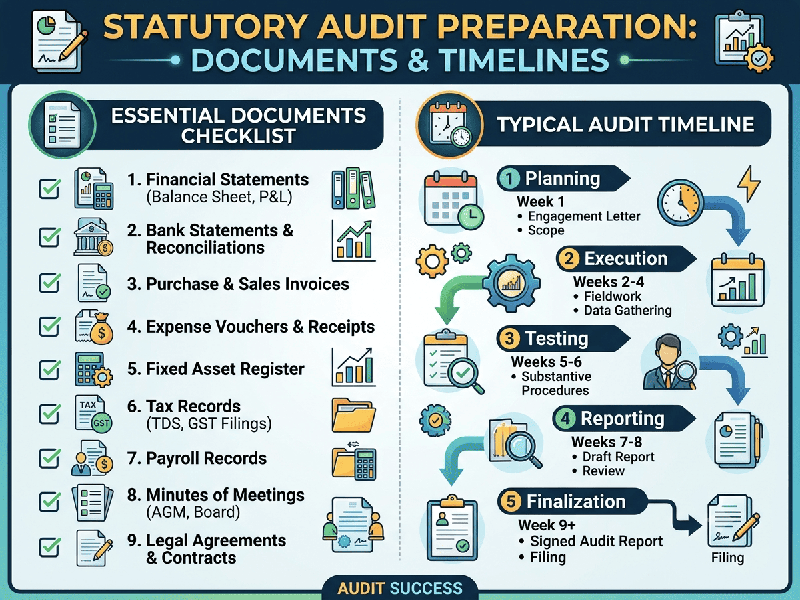
Statutory Audit Preparation: Documents and Timelines
A statutory audit requires structured preparation to
satisfy legal and accounting standards (e.g., Companies Act, Income Tax Act,
Ind AS / AS / IFRS). Organizing required records into a structured PBC
(Provided by Client) list ensures smooth execution and reduces audit
friction.
Phase 1: Pre-Audit Planning (30 to 15 Days Before
Audit Start)
Auditor Alignment: Finalize the audit engagement letter, audit schedule,
and formal PBC list with external auditors.
Sub-Ledger Freeze Date: Set firm cut-off dates for Accounts
Payable (AP), Accounts Receivable (AR), inventory adjustments, and expense
bookings.
Third-Party Confirmations: Prepare formal balance confirmation
requests for banks, key customers, suppliers, and legal counsel.
Phase 2: Document Compilation & Trial Balance
Finalization (15 Days to Day 0)
Trial Balance Finalization: Freeze the final Trial Balance (TB)
and map all GL codes to statutory financial statement line items.
Reconciliation Completion: Complete all primary balance sheet
reconciliations (Cash/Bank, AR, AP, Fixed Assets, Taxes, Intercompany).
Schedule Compilation: Draft detailed supporting schedules
for all balance sheet and P&L line items.
Phase 3: Audit Execution & Final Sign-Off (Audit
Period)
Fieldwork Support: Assign single-point-of-contact (SPOC) finance leads
for auditor queries and sample pulls.
Draft Financials Review: Review auditor adjustments, proposed
journal entries, and draft financial notes.
Management Representation Letter (MRL): Obtain board/CFO approval and sign
the MRL alongside final audited reports.
Comprehensive Statutory Audit Document Checklist (PBC
List)
1. Corporate Governance & Legal Records
Constitutional documents (Articles of Association,
Memorandum of Association, Certificate of Incorporation).
Board and General Meeting minutes books for the fiscal
year.
Updated register of Directors, Key Managerial
Personnel (KMP), and shareholding patterns.
Copies of material contracts, joint venture
agreements, lease deeds, and loan agreements.
2. General Ledger & Financial Statements
Final signed Trial Balance (TB) aligned with statutory
reporting formats.
Group consolidation sheets and intercompany
elimination schedules (if applicable).
Detailed General Ledger export with full transaction
history.
Schedule of all manual and period-end adjusting
journal entries with supporting documentation.
3. Cash, Bank & Treasury
Bank reconciliations for all operational, foreign
currency, and dividend accounts as of year-end.
Direct bank confirmation letters obtained from
financial institutions.
Physical cash count certificates signed by management
as of the closing date.
Fixed Deposit (FD) receipts and interest accrued
calculations.
4. Revenue, Sales & Accounts Receivable
Customer aging analysis matching the General Ledger
total.
Direct balance confirmations from top clients
(covering at least 70–80% of outstanding AR).
Cut-off testing files: Last 10 invoices/shipping notes
of the current year and first 10 of the next year.
Expected Credit Loss (ECL) or bad debt provision
calculations and write-off approvals.
5. Procurement, Expenses & Accounts Payable
Vendor aging summary reconciled with the General
Ledger.
Direct vendor confirmation letters for major
suppliers.
Unrecorded liabilities schedule and Goods Received Not
Invoiced (GRNI) clearing report.
Supporting documents for major operating expense heads
(rent agreements, utility bills, professional fees).
6. Inventory & Fixed Assets
Physical inventory count sheets signed by observers,
including reconciliation of variances to the ledger.
Inventory valuation sheets (verifying lower of cost or
net realizable value).
Fixed Asset Register (FAR) fully reconciled with the
General Ledger.
Additions and disposals schedule with supporting
invoices, POs, and capital WIP details.
Depreciation and amortization calculation sheets per
statutory rates/useful life models.
7. Statutory Taxes & Payroll Compliance
Direct Tax: Income tax returns, advance tax payment receipts, and
deferred tax computation schedules.
Indirect Tax: Annual reconciliation of GST/VAT returns against general
ledgers (e.g., GSTR-1, GSTR-3B vs. GSTR-2B matching).
Withholding Tax / TDS: Quarterly withholding tax returns,
challans, and reconciliation with ledger accounts.
Payroll: Annual payroll summary, PF/ESI/statutory contribution
receipts, and bonus/leave encashment actuarial valuation reports.