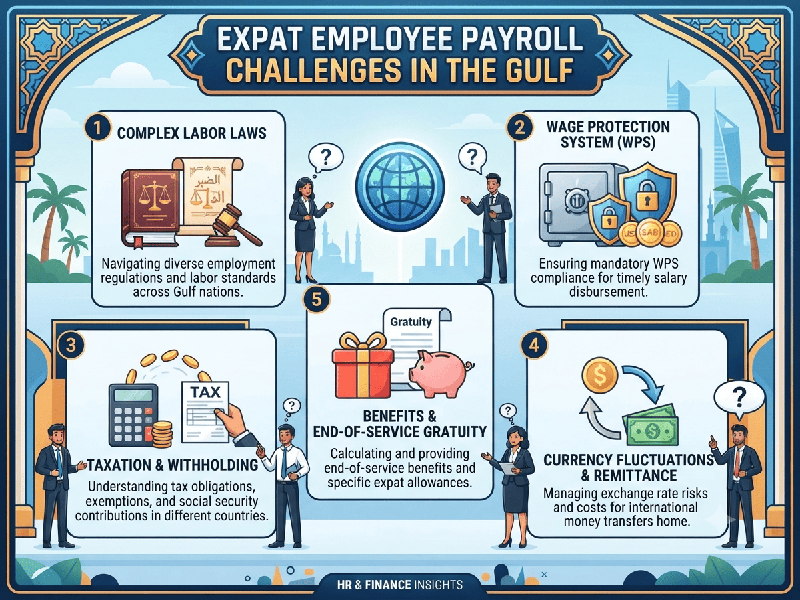
Expat Employee Payroll Challenges in the Gulf
Managing expat employee payroll in the Gulf (GCC)—across
Bahrain, Kuwait, Oman, Qatar, Saudi Arabia, and the UAE—comes with unique
regulatory, financial, and operational hurdles. While most GCC states do not
levy personal income tax on salaries, payroll is heavily policed through
electronic wage monitoring, strict contract-to-pay matching, and statutory exit
payouts.
1. Strict Wage Protection System (WPS) & Contract
Reconciliation
All six GCC states enforce electronic wage monitoring
systems (such as UAE WPS, Saudi Arabia’s Mudad, and Qatar’s WPS) to verify that
expat workers are paid accurately and on time.
Contract-vs-Payroll Mismatches: Systems validate monthly bank
transfers directly against registered employment contracts. Unexplained
deductions, unpaid leave without formal documentation, or bonuses paid outside
approved channels can trigger automated compliance flags.
Operational Penalties: Non-compliance is not just a
fine—missed deadlines or percentage shortfalls can freeze new work
visas/permits, block government portals, or escalate to legal penalties.
Local Currency & Approved Banks: Salaries generally must be disbursed
in the local GCC currency through locally licensed banks or exchange houses
using country-specific file formats (e.g., SIF files in the UAE).
2. End-of-Service Benefits (EOSB / Gratuity)
Complexity
Because most expat workers are excluded from national
state pension schemes, employers must calculate and fund statutory End-of-Service
Benefits (EOSB):
Country-by-Country Formulas: Calculations vary sharply across
borders. For example, the UAE accrues 21 days of basic salary per year for the
first 5 years and 30 days thereafter; Saudi Arabia uses half a month for the
first 5 years and a full month thereafter (with reductions if the employee
resigns early depending on tenure); Oman grants a full month’s basic salary per
year under its updated labor law (requiring split-period math for pre-July 2023
hires).
Basic Salary vs. Allowances: Gratuity and overtime are calculated
on basic salary, not gross pay. Poorly structured packages—or failing to
separate housing, transport, and cost-of-living allowances in
contracts—frequently spark labor disputes at termination.
Alternative Savings Schemes & Accruals: Employers must accrue growing,
uncapped EOSB liabilities monthly on the balance sheet and track voluntary or
mandatory savings/pension alternatives (such as the UAE’s voluntary EOSB
savings scheme or DIFC’s DEWS).
3. Expat Allowances, Benefits & Shadow Payroll
Expat compensation packages rarely consist of a simple
base salary:
Complex Allowances & Reimbursements: Payroll teams must track recurring
and annual expat entitlements—housing and schooling allowances, annual
repatriation airfare tickets, relocation/mobilization bonuses, and medical
insurance tiers—each with distinct eligibility and proration rules.
Home-Country Tax & Social Security (Shadow
Payroll): While
local GCC income tax is zero, seconded expats from countries like the US, UK,
or India may still owe home-country taxes or social security contributions,
requiring shadow payroll tracking, split-pay arrangements, and foreign
exchange (FX) cut-off coordination.
4. Partial Social Insurance & Visa-Linked
Onboarding/Offboarding
Non-Zero Statutory Contributions: Even when expats are exempt from
local retirement pensions, employers still owe mandatory statutory
contributions—such as occupational hazard coverage (2% under Saudi GOSI) or
unemployment insurance schemes (such as UAE Involuntary Loss of Employment, ILOE).
Immigration-Tied Payroll Cycles: An expat cannot legally be added to
WPS payroll until residency visas, Emirates ID / Iqama / QID numbers, and local
IBANs are active—often creating onboarding bottlenecks for first-month pay.
Conversely, final settlements must be calculated and signed off rapidly (e.g.,
within 14 days in the UAE) before residency visas can be canceled.
Bilingual Documentation: Official labor contracts, payslips,
and ministry notices require Arabic or bilingual Arabic/English formatting,
creating translation and compliance risks for centralized global HR teams.